Search RJ's Blog

Showing posts with label Christian Life. Show all posts

Friday, May 3, 2013

SBTS Online

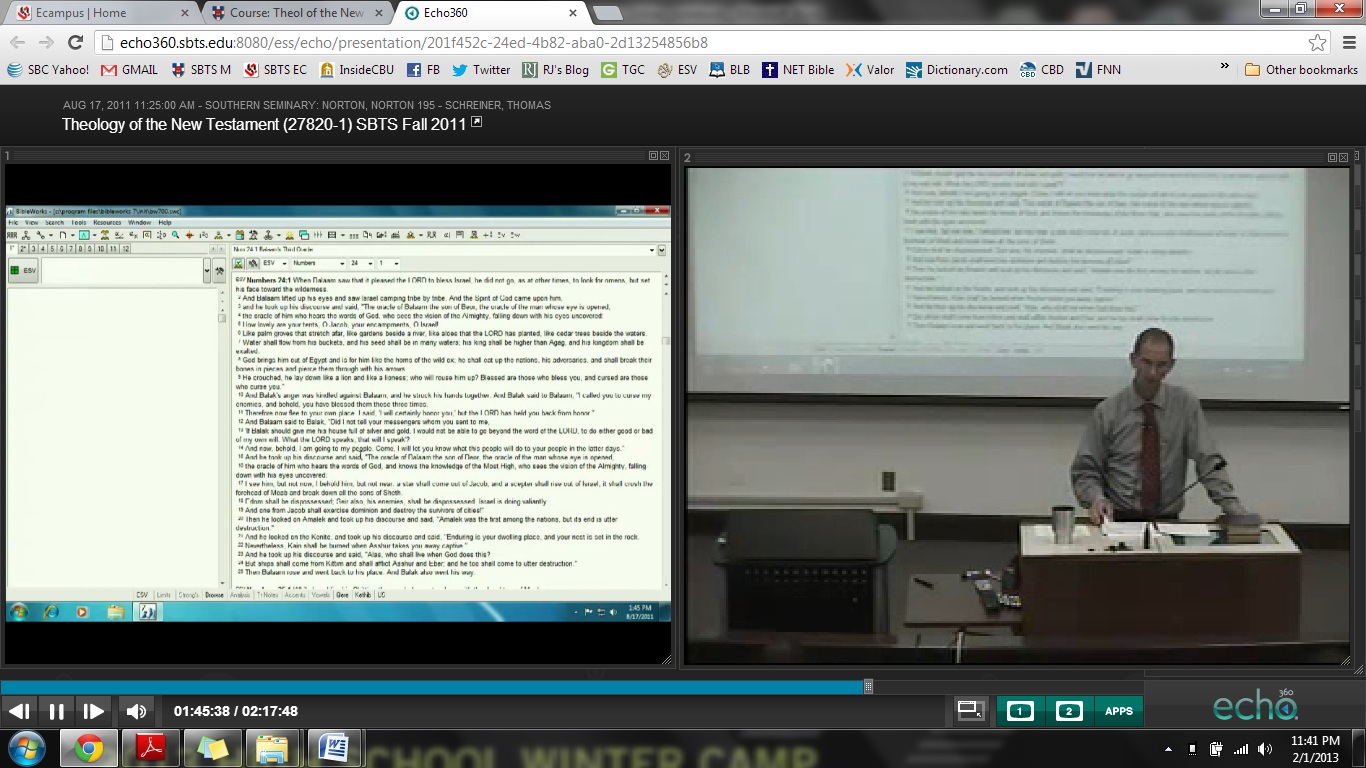
Going to school online has been very challenging but extremely beneficial. I have been challenged to meet the demands of each class. Yet, I have the flexibility of taking the courses online to manage my schedule throughout each week. Thus, my experience has been pretty awesome. I am impressed with the online Moodle database I use at The Southern Baptist Theological Seminary. Below are some screen shots of the different styles of courses. 


Some classes are in-class lecture videos, and others are more of a personal in-office lecture videos. I really enjoy the personal in-office lecture videos better because they cover more information and move along quickly compared to the extremely long in-class lecture videos. Sometimes the in-class lectures have question periods which make the video very boring and disengaging since you cannot ask a question. The in-office videos, however, are very inductive keeping the student engaged with the content.

If you are looking for a seminary that has the scholarship and evangelical foundations, SBTS is the school you want to attend. A majority of leading theologians and OT/NT scholars all teach at this seminary, so it is worth the investment if you need to go online.

Tuesday, April 2, 2013

Dr. Wellum @ SBTS

I am truly blessed as a seminary student at The Southern Baptist Theological Seminary. One of my professors, Stephen Wellum, is one of the leading systematic theologians in evangelicalism. I am impressed by the amount of biblical information this man of God knows, but even more impressed by how he communicates theological matters and always brings everything back to the centrality of the gospel.  Every class begins with prayer and ends with prayer. He comes off incredibly smart and humble in my class lectures and interactions (especially if you do not agree with him on something, he explains things very gracefully and responds systematically). I hope to meet him this summer on campus at SBTS and share with him the things I have been learning.

I have two courses with Dr. Wellum this Spring semester, and because of these classes so far, my theological and hermeneutical understandings have developed significantly. I guess this blog entry is a kind of tribute because he has contributed to my theological formation. Thanks for being a great teacher, Dr. Wellum!

He has required the most reading I have ever had in school so far (10 of my 12 books are required for his classes among my three courses). The reason why Dr. Wellum provides all of the reading is to challenge students so they can develop a comprehensive and objective understanding of topical information (i.e. God, Christ, Scripture, etc). I have definitely achieved that goal. With the all of the required reading comes his passionate lectures. If you ever hear him teach, it is clear that he cares deeply about the primary text, i.e. Word of God, and desires to glorify Jesus. Both of my courses discuss the person and work of Christ, and as a result have learned many great things about the Lord.

I found out that his "Jesus courses" are going to be summed up into a magisterial writing in the theology series, Foundations of Evangelical Theology. I am looking forward to his new book to come out next year and have him possibly sign it at ETS San Diego in 2014. It will be the leading Christian theology book on Jesus Christ for sure, which is my favorite subject! It's all about Jesus, and that's why I enjoy Dr. Wellum's courses so much.

Monday, March 4, 2013

What Is Sin - John Piper

There are so many definitions of sin in various Bible dictionaries. My favorite definition of sin is from a sermon by John Piper. It is very encouraging, convicting, educational and biblical! It is quoted below.

What is sin?

It is the glory of God not honored.
The holiness of God not reverenced.
The greatness of God not admired.
The power of God not praised.
The truth of God not sought.
The wisdom of God not esteemed.
The beauty of God not treasured.
The goodness of God not savored.
The faithfulness of God not trusted.
The commandments of God not obeyed.
The justice of God not respected.
The wrath of God not feared.
The grace of God not cherished.
The presence of God not prized.
The person of God not loved.

That is sin!

- John Piper

Sunday, February 10, 2013

How's Your Bible Reading Going?

I came across an article not to long ago about Bible illiteracy and Christians who fail to read the Bible. I had to copy the article and post it on my blog for future references so I can locate it since there are so many good points that are practical for ministry and life. It is so important we become Bible readers for life. God wants us to know his "whole counsel [OT and NT]" (cf. Acts. 20:27), and study it (cf. 2 Tim. 2:15). The Bible is the most important book we can read in our lives because it does not just inform you, but it transforms you because it is God's Word! As A.Z. Conrad once said, "The Bible outlives, out lifts, outloves, outreaches, outranks, outruns all others." I believe this article will help you see where you are in your reading of Scripture, and what you need to do to increase your reading of Scripture.

The article was posted on the Gospel-Coalition:
"January has come and gone. A little more than 8 percent of 2013 has already passed. Now is an especially good time to ask ourselves (and each other!) how our personal Bible reading is going. Many of us began a new Bible reading plan on January 1. Such plans can be helpful. You should try one. They can help you to be more consistent in your Bible reading; they can help to get you into a steady, daily diet of the Word; they can help you get through whole books and into previously unexplored parts of the Bible over the course of the year. It's never a bad time to get going on one or get back on one. 
Regardless of your Bible reading plan (or lack thereof), you probably had a general desire for your Bible reading to be better in 2013 than it was in 2012—to read more, to read more consistently, to read more thoughtfully, to read more passionately, and/or to better apply it to our daily life. So how's it going? Maybe so far in 2013 your Bible reading hasn't gone according to plan; it hasn't increased or improved as you'd hoped. Let me suggest several possible reasons why Bible reading might feel weak and wearisome, and suggest some ways in which those weaknesses might be helped. 
Maybe you're a type-A personality who's fallen behind on your reading plan. 
Maybe you're using a plan that assigns texts to specific dates. Falling behind means you're now on the wrong date. So you leave the Bible alone and decide to straighten or alphabetize something. Don't! Just keep going. Or switch to a reading plan that doesn't use dates. Remember, Bible reading plans were made for Bible reading; Bible reading was not made for Bible reading plans. 
Maybe you've become accustomed to not eating. 
If we fast from food for a few days our bodies become accustomed to not eating. The Bible is likened to food more than once (e.g., 1 Peter 2:2). We need it for our spiritual survival and sustenance. But if it's been a long time since you've had a steady diet of the Word, your spiritual stomach has shrunk and become indifferent to spiritual nourishment. This isn't healthy, and it can't go on indefinitely. So resolve to nurse yourself back to health even if you have to start small. 
Related, maybe your new reading plan is too rigorous, at least for now. 
Whether you have a spiritual appetite or not, you may have bitten off a bit more than you can chew. Going from a random verse for the day to the McCheyne Reading Plan is a step in the right direction, but if you're not keeping up with McCheyne, you might try doing it at half or one-fourth of the pace. 
Maybe you're approaching your Bible reading in a performance-based way. 
 It's good to keep track of progress no matter the discipline. But if you're reading the Bible only to feel better about yourself or appease God then a checklist can be dangerous. Go to the Bible to get more of God, not to get more gold stars. Go to the Bible to get your soul happy in God, not satisfied in yourself. 
Maybe you're paralyzed with guilt for having done poorly yesterday. 
Have you ever felt unworthy to pray or open the Bible? I have. How ironic when it's a book about and for sinners who need grace. We need the Bible most when we've read and obeyed it the least. Confess your sin boldly and in faith open your Bible to find comfort. Soak yourself afresh in the gospel. 
Maybe it feels dry, mechanical, and, truth be told, you even wonder why regular Bible intake is needed. 
Here's where another discipline should be partnered with Bible reading: preaching to yourself about what the Bible is, what it does, and why you need it. Psalm 119 is basically 176 verses of this encouragement. When the Bible feels stale and our reading feels empty, go to Psalm 119. Pray to God and preach to yourself about the need to feel the weight and worth of God's Word in our lives. 
Maybe you have false expectations about the work and discipline of Bible reading. 
Are you under the mistaken impression that Bible reading is easy and glorious if you're spiritual enough? Remember, Paul told Timothy, "Discipline yourself for the purpose of godliness" (1 Timothy 4:7). It is not unspiritual to do what the flesh resists. Determination, resolve, and self-discipline are necessary for even the most consistent and experienced Bible-readers. 
Maybe you have too high of expectations for this season of life. 
Perhaps you're a mom of a few tots. Before children, your times of Bible reading and praying were sweet, slow, and steady. Praise God for those seasons! But you're not in one of them now. Do what you can, starting with reading this new mom's testimony and this good advice from Don Whitney. 
Maybe you're in a part of Scripture right now that is new and unfamiliar to you. 
Maybe you don't understand the "big picture" of the story. The Bible is a big book; it is a long, multi-millennia story, each part building upon and pointing to others. Maybe you didn't grow up in church hearing the stories of the Old Testament. Then again, many of us grew up in church hearing the stories but still have no idea in what order they go or if it even matters. A little book, God's Big Picture, is helpful in laying out, well, the big pictureof the Bible. Read it alongside your Bible plan. 
Maybe you find yourself all too often scratching your head wondering what a word or phrase means. 
If so, get something like the ESV Study Bible. Look down in the footnotes when you need some help. Go to the back for a longer explanation about a biblical or theological concept. Or check out this article that recommends other resources for interpreting the Bible. 
Maybe you haven't found a consistent time or place to do Bible reading and prayer. 
Habits form much more easily with consistency. In our busy culture, consistency has to be planned. Chances are, there are some bad times of the day for you to try to read and pray. Chances are, there some good and some bad places in your home for Bible reading. Find the best spot at the best time and keep to it. By God's grace, in time, it will become a sweet, familiar place and time for you to meet with the Lord. 
Maybe you're compartmentalizing your Bible reading from the rest of your day. 
Healthy Bible intake seeks to bring the Bible to the whole of life. No matter how consistent our schedule, if our thoughts about the Bible are separated by 23 or more hours, we will not use our "swords" like we should. Here's a practical recommendation: No matter the amount of Bible you read in your "quiet time," take one verse, something that stood out to you, and write it on a 3x5 card or sticky tab. Put it in your pocket, on your desk, or on your dash. Several times per day look at it, say it, think on it, pray it back to God. If the Bible is like food and eating, remember, snacks are good! 
Maybe this part of your life is actually too personal.  
Do you have anyone in your life who will ask you how it's going and what you've been reading? If not, seek one out. Find someone and read the Bible together. Find a more mature friend who can help you with how to read and understand the Bible. 
I could go on and on with possible diagnoses for the shortcomings of our Bible reading. I know because I have experienced these and many others myself. Maybe you, too, see yourself in one or more of these diagnoses. Don't think I intend to make Bible reading more complicated or to simply add more tasks. Use this list as a diagnostic tool to help you narrow in on one or two practical or spiritual ways that Bible reading is hindered and might be helped. This thing of God's Word is "no trifle for you, but your very life" (Deuteronomy 32:47). May God do great things in us through his Word in the rest of 2013.

Wednesday, January 30, 2013

Doing the Little Things at Church

Lately I have been reflecting on my spiritual birthday, i.e. the day I came to faith in Jesus Christ. It will be in August this summer. The fact of the matter is that I have been a Christian for ten years. I cannot believe how GOD rescued me from my sins and blessed me with a new life through faith in Jesus Christ. I remember when I gave my life to Christ after a powerful message of the about the Ten Commandments in 2003. The Word of God convicted my heart, and I repented of my sins with the hope of never going back to my old high school ways during my senior year. Once I graduated, all of my desires changed for the glory of God as I began to serve at my church.

At my church, Harvest Christian Fellowship, I began doing the little things at my church in the high school ministry:
1. I began ushering in high school ministry.
2. I began participating with street witnessing.
3. I began assisting with community projects.

Being used at church gave me a sense of family and duty. It also opened new opportunities for me to serve at different capacities and more responsibility:
1. I began leading small groups.
2. I began counseling students at retreats.
3. I began teaching Bible studies.

Once I began doing this in the student ministries, it was only natural to do it on Sunday nights at Day 7 service where my high school pastor was also teaching:
1. I began ushering.
2. I began follow-up counseling.
3. I began leading small groups.

It was fun to help the ministry and overall function of the service. I had no idea how important my impact was to help the body of Christ until someone told me that I was a great example. It was definitely a positive life lesson I will never forget about being a servant. I just made myself available to do whatever needed to be done. If the parking lot ministry needed a hand, I was there. If the ministry needed security on campus, I did it. If communion and baptism services needed assistance, I would volunteer to serve others.

Doing the little things made me understand how to be a servant and be faithful in the little things. Because I was faithful in the little things, I was given the opportunity to go on mission trips and lead Bible studies:
1. I went on several disaster relief mission trips.
2. I went on several SWAT trips.
3. I went on several Harvest Crusade trips.
4. I went on several community service projects.

After serving for several years in the high school ministry, I decided to develop my faith in order to increase my knowledge and grow in my faith:
1. I completed the Growth classes.
2. I completed the Prayer & Share classes.
3. I completed the Leadership Essentials classes.

Once I completed these courses, I began teaching weekly the high school students at the satellite campus my wife and I attended for almost four years. I also began teaching doctrine classes and small Bible studies at the church on a teaching rotation. Furthermore, I was a leader for the men's sports ministry for six straight years and created my own team called Sanctified. God is truly remarkable for giving me the opportunities at my church. Yet, he has given me these opportunities because I was doing the little things at church.

At the height of my service, the opportunity presented itself to me to go to CBU and get my B.A. in Christian Studies. As I got my degree, I reconsidered my career in life to do Christian ministry and education. Now I am going to seminary at the Southern Baptist Theological Seminary for an M.Div. with concentration of biblical and theological studies. God is amazing how he works things out for his glory and my greater good.

All of the little things that I have done has taught me how to be a servant in regards to the ministries presented before me in my life. Therefore, I wait eagerly for the next steps God has for me I fulfill his calling in my life and continue to do the little things. There are no superstars in ministry; only servants. It is all about doing the little things, and one day, God will give those who are faithful bigger things to do for his kingdom. Amen!

Sunday, January 27, 2013

Just Do Something: A Liberating Approach To Finding God's Will

Recently, the high school ministry has begun a new book among the leadership. The book is called Just Do Something: A Liberating Approach To Finding God's Will by Kevin DeYoung. I have listened to many sermons on God's will, and I have also read plenty of books on God's will. Yet, DeYoung brings a fresh approach that is more concise and clear than all of the previous material I have experienced.

Even though I have not completely finished the book, I can say from skimming through the pages, the content of this book is wrapped in theological and biblical realities that have been forsaken for many years by Christians because of misconceptions and conventional interpretations of "God's will for my life." DeYoung debunks the old conventional interpretations of God's will and reinforces God's will in three general categories: (1) God's will of decree, (2) God's will of desire, (3) God's will of direction.

God's Will of Decree. 
The Creator of the heavens and the earth is the sovereign God of all things. He is sovereign over everything that exists, because everything exists by his will of decree. Nothing happens by mistake or accident because all things are ordained and predestined by him and for him. God is in control of everything that transpires in the universe. What God wills, will happen, and what happens is according to God's will. (e.g. Dan. 4:35; Eph. 1:11; Col. 1:16; Rev. 4:11)

God's Will of Desire.
The Creator of the heavens and the earth has revealed himself through the Word of God. Through the Scriptures, commandments and precepts and statutes have been communicated to make known God's will of desire. The desire is centered on obedience and conformity to the authority of Scripture. God desires for man to reflect his image and be reconciled to him. Therefore, God's will of desire is for man to be saved and live obediently to his Word, and in such obedience, live in the will of God. (e.g. John 6:40; 1 John 2:15-17; Heb. 13:20-21; Matt. 7:21; Deut. 29:29; Phil. 2:12-13).

God's Will of Direction.
The Creator of the heavens and the earth did not create a special plan for our lives to figure out or discover by walking through life in a spiritual corn maze or walking on a tightrope to reach the other side and find God's will. Yes, God has a plan for our lives, but it is not up to us to discover it, but rather just do something that encompasses and understands God's decree and desire together. It is true that God has purposed everyone from the foundation of the world to "just do something." By understanding God's will of decree as "how things are," and by understanding God's will of desire as "how things ought to be," understanding God's will of direction is simple and biblical: seek first the kingdom of God and his righteousness, while trusting in his sovereignty by faith to provide for all necessary needs. Thus, to know what "God's will is for my life" is to know God is sovereign and is satisfied with those who obey the Word of God. The Westminster Catechism explains God's will for everyone with a simple opening sentence, "Man's chief end is to glorify God, and to enjoy him forever."

Sunday, December 23, 2012

Accepted! - Southern Baptist Theological Seminary

This Christmas I received a very important document in the mail. I received an acceptance letter from the Southern Baptist Theological Seminary (SBTS)! I cannot believe that I have been accepted and will begin classes in 2013. Thank you to all who wrote a recommendation for me. I believe it is non-debatable to suggest a better school than SBTS for ministry even though there are many good schools. I believe SBTS is the best traditional and evangelical seminary in the United States under the leadership of the school president, Albert Mohler. His evangelical leadership and faculty is second to none recently, and to have the opportunity to go to this well establish institution is truly an honor.

Below is a video explaining the purpose and goal of SBTS, and what it is like to go to seminary and come out of seminary equipped to full the Great Commission.


Here is a link to the school's website if your interested in what they offer:
Southern Baptist Theological Seminary

Here is a link to the school of theology where I have been accepted:
School of Theology at Southern Baptist Theological Seminary

Here is a link to my master's degree and the classes I will have to take to graduate:
M. Div. - Concentration in Biblical & Theological Studies

I am excited to fulfill the words of the Apostle Paul in 2 Timothy 2:15, "Do your best to present yourself to God as one approved, a worker who has no need to be ashamed, rightly handling the word of truth."

I know the Lord has called me to go to seminary, however, I am being patient to see how everything is going to be provided for in the future. The first step is going out in faith to see if I would get accepted into seminary. The second step is to prioritize things in order to take courses and be on track to graduate in an appropriate fashion, while getting the most out of my seminary experience. As this opportunity has presented itself to me, and I am ready to go all in for the Lord Jesus Christ!


Thursday, December 20, 2012

What To Give Jesus For His Birthday

At church last weekend, I was reminded about six things we can give Jesus for his birthday. Christmas is about celebrating the incarnation, birth, and coming of the Messiah, Jesus Christ. He was given gifts of gold, frankincense, and myrrh. The gifts were real, and symbolically pointed to his identity as the King of salvation. Throughout the birth narratives of Jesus (see Matthew 1-2, Luke 1-2), the characters involved in the story all worship Jesus. Thus, worshiping the Lord Jesus Christ is one of the main themes of the incarnation, birth, and coming two thousand years ago which reveals one of the main themes for Christmas.

However, in the 21st century, how do you give "God" something? Theologically, there is nothing that God needs, or is there anything we can give him. Spiritually, there are things God desires us to do, however, which are given to God through our personal ethic of worship and service for His glory. The things he desires for us to do are always linked together with His glory, and what is linked to his glory is always for our greater good. Therefore, Christmas can be a revival like experience if one allows it by giving to God specific things that will give him glory. The things we can "give" to God are predicated on our need for him. Giving must be selfless because it is always sacrificial, beneficial, and most importantly biblical.

Here are six things we can give the Lord Jesus Christ for Christmas (his birthday):

1. We can give Jesus our time.

2. We can give Jesus our love.

3. We can give Jesus our praise.

4. We can give Jesus our giving.

5. We can give Jesus our thanks.

6. We can give Jesus our trust.

Thursday, November 22, 2012

Thankful for Theology

This year I wanted to write about how I am thankful for theology (that is true, biblical, and Christ-centered theology). C.S. Lewis mentions in his book, Mere Christianity, about how important theology is for all people and the world:
"Every­one has warned me not to tell you what I am going to tell you in this last book. They all say ‘the ordi­nary reader does not want The­ol­ogy; give him plain prac­ti­cal reli­gion’. I have rejected their advice. I do not think the ordi­nary reader is such a fool. The­ol­ogy means ‘the sci­ence of God,’ and I think any man who wants to think about God at all would like to have the clear­est and most accu­rate ideas about Him which are avail­able. You are not chil­dren: why should you be treated like children? In a way I quite under­stand why some peo­ple are put off by The­ol­ogy. I remem­ber once when I had been giv­ing a talk to the R.A.F., an old, hard-bitten offi­cer got up and said, ‘I’ve no use for all that stuff. But, mind you, I’m a reli­gious man too. I know there’s a God. I’ve felt Him out alone in the desert at night: the tremen­dous mys­tery. And that’s just why I don’t believe all your neat lit­tle dog­mas and for­mu­las about Him. To any­one who’s met the real thing they all seem so petty and pedan­tic and unreal!’

Now in a sense I quite agreed with that man. I think he had prob­a­bly had a real expe­ri­ence of God in the desert. And when he turned from that expe­ri­ence to the Chris­t­ian creeds, I think he really was turn­ing from some­thing real to some­thing less real. In the same way, if a man has once looked at the Atlantic from the beach, and then goes and looks at a map of the Atlantic, he also will be turn­ing from some­thing real to some­thing less real: turn­ing from real waves to a bit of coloured paper. But here comes the point. The map is admit­tedly only coloured paper, but there are two things you have to remem­ber about it. In the first place, it is based on what hun­dreds and thou­sands of peo­ple have found out by sail­ing the real Atlantic. In that way it has behind it masses of expe­ri­ence just as real as the one you could have from the beach; only, while yours would be a sin­gle glimpse, the map fits all those dif­fer­ent expe­ri­ences together. In the sec­ond place, if you want to go any­where, the map is absolutely nec­es­sary. As long as you are con­tent with walks on the beach, your own glimpses are far more fun than look­ing at a map. But the map is going to be more use than walks on the beach if you want to get to America.
Now, The­ol­ogy is like the map. Merely learn­ing and think­ing about the Chris­t­ian doc­trines, if you stop there, is less real and less excit­ing than the sort of thing my friend got in the desert. Doc­trines are not God: they are only a kind of map. But that map is based on the expe­ri­ence of hun­dreds of peo­ple who really were in touch with God-experiences com­pared with which any thrills or pious feel­ings you and I are likely to get on our own are very ele­men­tary and very con­fused. And sec­ondly, if you want to get any fur­ther, you must use the map. You see, what hap­pened to that man in the desert may have been real, and was cer­tainly excit­ing, but noth­ing comes of it. It leads nowhere. There is noth­ing to do about it. In fact, that is just why a vague religion-all about feel­ing God in nature, and so on-is so attrac­tive. It is all thrills and no work; like watch­ing the waves from the beach. But you will not get to New­found­land by study­ing the Atlantic that way, and you will not get eter­nal life by sim­ply feel­ing the pres­ence of God in flow­ers or music. Nei­ther will you get any­where by look­ing at maps with­out going to sea. Nor will you be very safe if you go to sea with­out a map.
In other words, The­ol­ogy is prac­ti­cal: espe­cially now. In the old days, when there was less edu­ca­tion and dis­cus­sion, per­haps it was pos­si­ble to get on with a very few sim­ple ideas about God. But it is not so now. Every­one reads, every­one hears things dis­cussed. Con­se­quently, if you do not lis­ten to The­ol­ogy, that will not mean that you have no ideas about God. It will mean that you have a lot of wrong ones — bad, mud­dled, out-of-date ideas. For a great many of the ideas about God which are trot­ted out as nov­el­ties to-day are sim­ply the ones which real The­olo­gians tried cen­turies ago and rejected. To believe in the pop­u­lar reli­gion of mod­ern Eng­land is ret­ro­gres­sion — like believing the earth is flat."
Theology matters. Theology is so important because it discloses the truth. Several years ago when I was teaching high school ministry at Harvest: Orangecrest, I taught through the book of Colossians and entitled one of my messages, "The Thankful Theologian" (read my sermon notes here). I mentioned how Paul was thankful for the believers in Colosse, but more important for good theology that was lived out by godly believers.

He gives thanks for godly believers:
"We always thank God, the Father of our Lord Jesus Christ, when we pray for you, since we heard of your faith in Christ Jesus and of the love that you have for all the saints, because of the hope laid up for you in heaven. Of this you have heard before in the word of the truth, the gospel..." (Colossians 1:3-5)

He gives thanks for good theology:
"Giving thanks to the Father, who has qualified you to share in the inheritance of the saints in light. He has delivered us from the domain of darkness and transferred us to the kingdom of his beloved Son, in whom we have redemption, the forgiveness of sins." (Colossians 1:12-14)

Good theology transformed Paul's life and those who where his hearers (as it did for C.S. Lewis). There was a lot of bad theology in Colosse, and for that purpose Paul wrote them this letter of doctrinal significance. Those who had good theology (biblical), lived godly lives. Those who had bad theology (worldly), lived ungodly lives. The substance of bad theology in Colosse was grounded in the similar words of Jeremiah  7:28, "And you shall say to them, ‘This is the nation that did not obey the voice of the LORD their God, and did not accept discipline; truth has perished; it is cut off from their lips." Bad theology always ends in ruin because "truth has perished." Those with bad theology (or without theology) are usually people who are not thankful with perspective. They are described by the depravity language of Romans 1:21, "For although they knew God, they did not honor him as God or give thanks to him, but they became futile in their thinking, and their foolish hearts were darkened." Bad theology has futility in the mind and darkness in the heart. Praise God that Paul taught good theology to his hearers, and for all of us who read his letters get to read good theology as well.

I am thankful this Thanksgiving for theology because it has shaped my life in such a way that I can live with purpose and meaning. Theology has changed my perspective of life, and impacted my mission in life for the glory of God. Thank GOD for revealing himself so we could study, learn, and discourse about him in our lives!

Wednesday, November 21, 2012

From Pride to Humility - 1 John 2:16

Over the summer, I was given a small booklet on the biblical perspective of pride and humility. 1 John 2:16 says pride is not of God, but of the world, "For all that is in the world - the desires of the flesh and the desires of the eyes and pride of life - is not from the Father but is from the world." 

I received this booklet as an encouragement to avoid being prideful because it was misinterpreted that I was going around on purpose parading around my works (which I was excited to be apart of since I graduated from CBU). I could totally see how some of my words and actions could of been perceived as prideful, narcissistic, and puffed up after the discussion. Therefore, I humbly apologized and acknowledged forgiveness, and explained myself to make things clear and transparent. Initially, it is never a good feeling when someone calls you out (whether they are right or wrong), and thinks you are a prideful individual. Nevertheless, as I have wisely learned over many years in my youth, it is important to listen to people who think things like this because they not only see something that you cannot see in yourself, but they primarily and genuinely care about you and your well-being among others (and in this context, for my future success wherever the Lord sends me). I am thankful for people like this because they want the best to shine out of me for the glory of God. This was specifically the case with me.

The small booklet I was given is by Stuart Scott called, From Pride to Humility: A Biblical Perspective, which is a small except from the book, The Exemplary Husband. It is dated, but I am so grateful for this resource because it ministered to me in many ways by confirming to me the things that I am doing well, and the things I need to seriously consider.  Scott writes, "Pride is blinding...The question is not, 'Do I have it?' but, "Where is it?' and 'How much of it do I have?' We all have the tendency to think too much about ourselves and too much of ourselves." Scott goes on to lay out 30 different kinds of pride in order to try and expose any prideful manifestations of self-righteousness. Each one speaks of pride coming from thinking too much about yourself or of yourself compared to God and others:

Manifestations of Pride (by Stuart Scott)
1. Complaining against or passing judgment on God (cf. Num. 14:1-4, 9, 11; Rom. 9:20)
2. A lack of gratitude in general (cf. 2 Chron. 32:25)
3. Anger (Matt. 20:1-16)
4. Seeing yourself as better than others (Luke 7:36-50)
5. having an inflated view of your importance, gifts and abilities (1 Cor. 4:7)
6. Being focused on the lack of your gifts and abilities (1 Cor. 12:14-25)
7. Perfectionism (Matt. 23:24-28)
8. Talking too much (Prov. 10:19)
9. Talking too much about yourself (Prov. 27:2; Gal. 6:3)
10. Seeking independence or control (1 Cor. 1:10-13; Eph. 5:21)
11. Being consumed with what others think (Gal. 1:10)
12. Being devastated or angered by criticism (Prov. 13:1)
13. Being unteachable (Prov. 19:20; John 9:13-34)
14. Being sarcastic, hurtful, or degrading (Prov. 12:18, 23)
15. A lack of service (Gal. 5:13; Eph. 2:10)
16. A lack of compassion (Matt. 5:7, 18:23-25)
17. Being defensive or blame-shifting (Gen. 3:12-13; Prov. 12:1)
18. A lack of admitting when you are wrong (Prov. 10:17)
19. A lack of asking forgiveness (Matt. 5:23-24)
20. A lack of biblical prayer (Luke 18:10-14)
21. Resisting authority or being disrespectful (1 Pet. 2:13-17)
22. Voicing preferences or opinions when not asked (Phil. 2:1-4)
23. Minimizing you own sin and shortcomings (Matt. 7:3-5)
24. Maximizing others' sin and shortcomings (Matt. 7:3-5; Luke 18:9-14)
25. Being impatient or irritable with others (Eph. 4:31-32)
26. Being jealous of envious (1 Cor. 13:4)
27. Using others (Matt. 7:12; Phil. 2:3-4)
28. Being deceitful by covering up sins, faults, and mistakes (Prov. 11:3, 28:13)
29. Using attention-getting tactics (1 Pet. 3:3-4)
30. Not having close relationships (Prov. 18:1-2; Heb. 10:24-25)

On the contrary, Scott responses with the "put off and put on" principle. Colossians 3:9-10, "Seeing that you have put off the old self with its practices and have put on the new self, which is being renewed in knowledge after the image of its creator." Jay Adams, renowned Christian counselor and author, calls this the "De-habituation/Re-habituation" method. The practical response is to "put off" the manifestations of pride and "put on" the manifestations of humility. The goal is to remove any habitual, prideful characteristics and apply new habitual, humble characteristics. Scott ends his booklet with a list of 24 manifestations of humility towards about others or of God compared to yourself:

Manifestations of Humility (by Stuart Scott)
1. Recognizing and trusting God's character (Ps. 119:66)
2. Seeing yourself as having no right to question and judge God (Ps. 145:17; Rom. 9:19-23)
3. Focusing on Christ (Phil. 1:21; Heb. 12:1-2)
4. Biblical prayer and a great deal of it (1 Thess. 5:17; 1 Tim. 2:1-2)
5. Being overwhelmed with God's undeserved grace and goodness (Ps. 116:12-19)
6. Being thankful and grateful in general towards others (1 Thess. 5:18)
7. Being gentle and patient (Col. 3:12-14)
8. Seeing yourself as no better than others (Rom. 12:16; Eph. 3:8)
9. Having an accurate view of your gifts and abilities (Rom. 12:3)
10. Being a good listener (James 1:19; Phil. 2:3-4)
11. Talking about others only if it is good or for their good (Prov. 11:13)
12. Being gladly submissive and obedient to those in authority (Rom. 13:1-2; Heb. 13:17)
13. Preferring others over yourself (Rom. 12:10)
14. Being thankful for criticism or reproof (Prov. 9:8; 27:5-6)
15. Having a teachable spirit (Num. 22:22-35; 1 Tim. 3:1-8)
16. Seeking always to build up others (Eph. 4:29)
17. Serving (Gal. 5:13-14)
18. A quickness in admitting when you are wrong (Prov. 29:23)
19. A quickness in granting and asking for forgiveness (Eph. 4:32)
20. Repenting of sin as a way of life (1 John 1:9; 1 Tim. 4:7-9)
21. Minimizing others' sins or shortcomings in comparison to your own (Matt. 7:3-5)
22. being genuinely glad for others (Rom. 12:15)
23. Being honest and open about who they are and the areas in which they need growth (Gal. 6:2)
24. Possessing close relationships (Acts 20:31-38)
Monday, November 19, 2012

Run Hard For Christ - Philippians 3:12-14

After church yesterday, two specific things stood out to me in the sermon by Levi Lusko at Harvest (listen here). It is easy to talk about the "forgetting what's behind" and "straining for what's ahead" content of these verses because they are simple and straight forward. However, there were two things that were not straight forward, so I decided to dig deeper. The first thing was Paul's commitment to "press on" throughout his life to make every moment count for the gospel. The second thing was Paul's ambition "for the prize" that he would receive at the end of his life.

Philippians 3:12-14, "Not that I have already obtained this or am already perfect, but I press on to make it my own, because Christ Jesus has made me his own. Brothers, I do not consider that I have made it my own. But one thing I do: forgetting what lies behind and straining forward to what lies ahead, I press on toward the goal for the prize of the upward call of God in Christ Jesus."

"I Press On"
The Apostle Paul made it his goal to never stop broadcasting the gospel. His joyful letter to the Philippians was based on the fact the church was advancing and progressing the gospel in their city (Phil. 1:12, 25). Paul testified in his letter that he will always "press on" through whatever circumstances he faced as long at it resulted in the advancement of the gospel.

The Greek word for "press," dioko, is a verb with the dominant sense of persecution. However, it is translated "to press on," indicating Paul’s continuous and laborious determination to obtain eternal life regardless of his trials. The "press" language echoes the process of making wine in the NT. The grapes are pressed and crushed by foot, slab, or vat into a new wine. Paul saw his trials and decided to "press on" while he was getting pressed and crushed with persecution. It was a mentality of always getting back up after being struck down. As he was getting pressed and crushed, the advancement of the gospel was being poured out of his life as new wine.

Paul mentions dioko twice in these selected verses to assure two things with one common denominator. The first occurrence was to assure his audience that he has to still "press on" through sanctification in his Christian life ["make it my own"] because of his calling by Jesus Christ ["made me his own"]. The second occurrence was to demonstrate to his audience his heavenly motive ["towards the goal"] and objective ["for the prize of the upward call of God"] in gospel-centered ministry, knowing what awaited for him in glory. This is precisely why he mentioned knowing Christ and being promised eternal life is far better and of great gain throughout the letter (Phil. 1:27; 3:7, 8). Paul wanted to make sure the Philippians were going to "press on" through their persecution knowing what awaited them in eternity.

For the Prize
The Apostle Paul uses a metaphor describing an Olympian receiving a prize. The Greek word for "prize," brabeion, is found only twice in the NT. The first occurrence is in 1 Corinthians, referring to the literal prize given to an athlete who wins a competitive race (most likely referencing the ancient games that were held in Corinth). 1 Corinthians 9:24 says, "Do you not know that in a race all the runners run, but only one receives the prize? So run that you may obtain it."  Paul later contrasts how the perishable prize given to the victorious athlete [runner] is unworthy compared to the imperishable prize given to the victorious Christian who runs hard for Christ. Thus, the prize does not provide victory over opponents as the perishable prize would of signified, but the imperishable prize provides victory over the enemies of sin, Satan, and death through the promise of eternal life. What a glorious brabeion!

The second occurrence appears in Philippians 3:14. This occurrence provides more theological depth and understanding. Paul uses the same term, brabeion, yet intentionally refers to the glorious prize of eternal life. He makes it very clear that this prize is given by the prepositional phrase, "for the prize." Logically speaking, this means the prize has already been disclosed to all who desire to obtain it. Also, all those who desire to obtain it must be "in Christ Jesus." Those in Christ Jesus press on in their faith knowing the brabeion awaits them in the future.

Run Hard For Christ
In both occurrences, the athletic references hinge on the character of endurance. Runners have to train tenaciously. They have to constantly be progressing so they will finish the race. Running exerts a massive amount of energy and physicality. It is an exercise that demands sacrifice through endurance. When running a race, you have to "press on" and not give up. Paul maximizes this example in conjunction with will of God in the Christian life. Just as runners have to run hard with endurance in order to win, Christians need to run hard with endurance for Christ. To run hard means to sacrifice energy and physicality for the "upward call of God." Paul conveys a basic spiritual reality - one day we will be rewarded with "the prize"of eternal life. Thus, he was willing at all costs to "press on" to fulfill his gospel mandate while enduring through persecution, trials, and tribulations for the glory of God.

Here are a few notes of application that ministered to me as I reflected upon this text:
1. I need to have the advancement of the gospel at the epicenter of my life in order to press on through trials (as Paul did through his missionary trips). Focusing on the bigger pictures of the gospel will make my little pictures of trials seem insignificant.

2. I need to have a keen sense of my calling by the Lord Jesus Christ (as Paul did through his ministry). Reflecting on my regeneration with thanksgiving, and knowing my purpose in the kingdom will strengthen me to envision greater things I can do for Christ because of what he has done for me.

3. I need to have a heavenly perspective in order to fulfill the upward call of God (as Paul did through his life reflection). Knowing the prize of eternal life awaits for me one day will empower me to live for the glory of God in the present.

Wednesday, November 7, 2012

All I Want To Do - Acts 6:4

The other day I was asked by a few people, "What do you want to do?" Initially, I did not know what they meant. However, I assumed they were asking what I would be doing in the future. That was precisely the question. They wanted to know if I wanted to go into ministry since I have been serving at my church for many years with a joyful servant's heart. I paused and gave them my answer.

My answer was of course a positive one. I shared with them that my heart has been compelled by the gospel. Thus, with the rest of my life I want to primarily invest in all of my efforts to preach the Word of God in ministry, and teach the Word of God in education (as I mentioned my previous post, Back To Blogging!). In some of my older posts, it seems to read as if I do not want to be in full-time ministry, which is not true. I want to do more than just ministry when the opportunity presents itself. I want to teach the Bible academically at either a middle school, high school, or university as well. My desire is to educate students [and adults] with the Scriptures from the pulpit and in the classroom. In ten years, I pray and hope to see my long term goals come to life as a pastor and/or professor in the community. We will see what the God's will is for my wife and I!

The verse below perfectly, simplistically, and accurately defines all I want to do:
Acts 6:4, "But we will devote ourselves to prayer and to the ministry of the word."

The apostles were devoted. The apostles were devoted to prayer. The apostles were devoted to ministry. The apostles were devoted to the Word of God. Those who are devoted to "prayer" and the "ministry of the word" find themselves making right choices, living godly examples, and communicating truth to those around them as the apostles did. This is what I want to do. Amen!

What is your favorite subject in Christian Studies?