Showing posts with label Jesus. Show all posts
Showing posts with label Jesus. Show all posts
Saturday, June 1, 2013
Ravi Zacharias
I think Ravi Zacharias has some of the best content on YouTube regarding apologetics and Christianity. Here is a short video on his debate about Jesus Among the other gods/religions. So compelling!

Monday, April 8, 2013
Fulfillment Formulae In Matthew's Gospel
 In the Gospel of Matthew, there is specific theme of "fulfillment" where the author uses OT texts to prove Jesus is the Messiah. This is know has the "fulfillment formulae" of Matthew. The formulae teaches us two things about the Lord. First, God's saving promises in the OT are being fulfilled. Second, God's saving promises in the OT are being fulfilled in the person of Jesus Christ. Schreiner points out how "the fulfillment theme in Matthew demonstrates that OT prophecy anticipated and pointed towards Jesus." The various Scriptures that Matthew quotes teach us that Jesus is the new King (Matt. 2:1-6), the true Israel (Matt. 2:13-15), the new exodus (Matt. 2:16-18; 4:1-11), and the new covenant (Matt.4:14-16). Jesus ultimately fulfills the Scriptures at his baptism when the Holy Spirit descends upon him to "fulfill all righteousness" and identify him as the Servant of the Lord in the OT who came to suffer and die for the sins of his own people (cf. Matt. 3:15; 8:14-17; 12:18-21; 21:5-6; 26:50-56).
The emphasis on fulfillment in Matthew is important to understand because the author was writing to Jewish Christians who were still trying to live in old law of Judaism and not in the new law of Christ. The defining words by Jesus in the Sermon on the Mount is the most profound fulfillment formulae usage that is not quoting an OT text to substantiate the claim, "Do not think that I have come to abolish the Law or the Prophets; I have not come to abolish them but to fulfill them. For truly, I say to you, until heaven and earth pass away, not an iota, not a dot, will pass from the Law until all is accomplished" (Matt. 5:17-18). Even thought these two verse to not mention an OT text, they do encapsulate the idea that Jesus came to fulfill the Scriptures because they were always intended for him to accomplish and bring salvation to his people because man could never fulfill and accomplish the law.
The fulfillment formulae reveals how God's saving plans are realized in Jesus Christ. Thus, Matthew's Gospel ranges from Abraham to David, to all of the Law and the Prophets, to showcase how Jesus' birth-life-death-resurrection was not an accident, but was the promised-plan from the beginning. Indeed, the fulfillment formulae displays the inauguration of God's saving purposes that was proclaimed and prophesied from the beginning in order to confirm his messiahship who will consummate all things in the end.
Friday, March 8, 2013
"Belief" In John's Gospel

The importance of "belief" in John's gospel is supported by the biblical data where the terminology occurs 98 times. Belief in John's gospel, however, carries "irony" towards belief that is thematically and theologically woven in the narrative and linked to the signs of Jesus (e.g. Jesus does signs to believe in him; Jews see signs and do not believe in him, [cf. John 1:11]).
John records the "signs" of Jesus to reveal his deity and manifest his glory, as in John 2:11, "This, the first of his signs, Jesus did at Cana in Galilee, and manifested his glory. And his disciples believed in him." The term "signs" are repeatedly used in John and wrapped up in the context of belief (cf. 2:23; 3:2; 4:48; 6:2, 26; 7:31; 9:16; 11:47 [12:37; 20:30]). However, the "irony of belief" is defined by the Jews rejecting Jesus in John 12:37, "Though he had done so many signs before them, they still did 'not believe' in him." This verse really points to the bigger theological meaning of "belief" in John. The Jews misunderstood the signs of Jesus, and as a result did not believe in him as the Messiah. The outcasts, however, understood the signs of Jesus, and as a result believed in him just as recorded in John 6:14, "When the people saw the sign that he had done, they said, “This is indeed the Prophet who is to come into the world!"For this reason, it is appropriate to suggest the "irony of belief" in John's gospel is fundamentally grounded in the biblical data which points to believing in Jesus as Messiah as the most superior determination according the gospel narrative.
Wednesday, March 6, 2013
Fabricating Jesus: How Modern Scholars Distort the Gospels

Evans provides six things believers can do to authenticate their beliefs as reasonable and true:
1. Historical Coherence - The historical circumstances in the Gospels are authenticated by the life and ministry of Jesus in real history because he claimed historical-theological realities that were true in that age.
2. Multiple Attestations - The historical accounts of the Gospels and other sources that attest to the same realities and existence of Jesus suggest the Gospels are reliable sources with historical importance.
3. Embarrassment - The historical material in the Gospels speak of characters in the narrative that would not be placed in a fabricated story because the narratives report accurate and real reports/witness of what transpired.
4. Dissimilarity - The historical continuity and harmony of the fourfold Gospels all promote the same theological and ethical teaches of Jesus and do not suggest they were invented but rather original.
5. Semitisms and Palestinian Background - The historical context of the Gospels utilize the original languages, imply the readers to know cultural traditions of the first century, and mention many historical-geographical locations that are archaeological preserved to show evidence of the trustworthiness of the Scriptures.
6. Consistency (coherence) - The historical data of the Gospels in the previous five points dismiss skepticism and place Christianity on a pillar of reason and truth through a consistent burden of proof about the person of Jesus and the truth of Scripture.
The biblical "portrait" of Jesus and the "perspective" Gospels will always be distorted if such criterion is rejected and not methodologically and scholastically analyzed as all other ancient historical-religious documents.
It is important to herald the biblical Jesus and point out the illogical conclusions of these dishonest scholars who are influencing many students to believe in false interpretations of the Savior and the Scriptures. To do this, Evans suggest we should give a reason for our biblical beliefs about Jesus and the Word of God. Since dishonest scholars do not give any principle of sufficient reason, their arguments are very intimidating yet extremely weak. It appears they just attack the doctrines of Christianity as a bully pushes someone smaller around to make them appear bigger and stronger. The bully, however, when challenged with the same display of authority appears weak and recognizes his bullying tactics are weak and defeated.
In the same sense, Christians need to stand up to such scholarly bullying per se. All believers should stand up with intelligence, reason, and biblical data to support beliefs against anyone who questions the Christian faith. Christians can give a response with a principle of sufficient reason to point to the reality of truth in Christ. All things in Scripture should correspond with reality, and it is no surprise that Scripture is grounded in that criterion.
Saturday, March 2, 2013
The "I am" of the Old Testament In the New Testament

As I grew stronger in the grace and knowledge of the Lord Jesus Christ, I began to understand the theological significance of the claims of Christ. I understood the “I am” statements to reference Jesus as the all satisfying providential caregiver for all who believe in him, and only through faith in his gospel can anyone be saved.
Once I started Bible teaching on a regular basis at my church and later went to school to be educated in the Scriptures, I began studying the topic of the "I am" statements from an exegetical and canonical approach. As a result, I was exposed to the massive context of references in the OT. It became apparent that Jesus used the OT references and applied them to himself because he is God in the flesh, the self-revelation of God the Father.
The "I am" of the Old Testament In the New Testament
All of the “I am” statements fundamentally teach us what Jesus does for those who believe in him. Yet, the purpose of the “I am” statements is to teach us who Jesus is in the gospel of John.
In John’s gospel, there are multiple “I am” sayings. For sake of clarity, distinguishing them into two categories helps constructive interpretation and minimizes confusion. For that reason, John’s gospel reveals there are primary “I am” statements, and secondary “I am” sayings. Categorizing does not in any way minimize the importance of the sayings because all of them are equal in significance, meaning, and purpose. The statements are theological and exegetical referents to OT themes (i.e. bread/light/door/shepherd/vine). The sayings are biblical referents to OT titles of God (i.e. Pentateuch/Isaiah passages). There are seven primary "I am" statements, and seven secondary "I am" sayings in John. Nevertheless, both the “I am” statements and “I am” sayings directly reference OT theological titles and themes in the Pentateuch, and servant-oriented messianic functions in Isaiah to showcase a glorious literary rendering of the promises of God fulfilled in the Messiah Jesus.
The "I am" Revealed In the Pentateuch
Genesis is where the "I am" is revealed as the creator of the heavens and the earth, and the covenant maker with Abraham for all nations. Beginning with the John 8:58 "I am" reference in John's gospel, the theological titles in Pentateuch begin with God speaking to Abraham as his “I am.” Thus, God is the “I am” to Abraham and his sons in throughout the patriarchal narrative in Genesis:
Genesis 15:1, "I am your shield; your reward shall be very great.”
Genesis 15:7, “I am the Lord who brought you out from Ur of the Chaldeans to give you this land to possess."
Genesis 17:1-2, “I am God Almighty; walk before me, and be blameless, that I may make my covenant between me and you, and may multiply you greatly.”
After the “I am God Almighty” reference, the Pentateuch uses this as a referent to remember the “I am” as the God of Abraham (just as Jesus alluded to in John 8:58):
Genesis 26:24, “I am the God of Abraham your father. Fear not, for I am with you and will bless you and multiply your offspring for my servant Abraham's sake.”
Genesis 35:11, “I am God Almighty:1 be fruitful and multiply. A nation and a company of nations shall come from you, and kings shall come from your own body.”
Genesis 46:3, “I am God, the God of your father. Do not be afraid to go down to Egypt, for there I will make you into a great nation.”
Exodus reveals God himself as the “I am who I am.” Thus, God revealed himself as the "I am" of Israel:
Exodus 3:6, “And he said, “I am the God of your father, the God of Abraham, the God of Isaac, and the God of Jacob.” And Moses hid his face, for he was afraid to look at God.
Exodus 3:14, “God said to Moses, “I am who I am.”1 And he said, “Say this to the people of Israel, ‘I am has sent me to you.’”
Exodus 6:2, “God spoke to Moses and said to him, ‘I am the Lord’” (cf. 6:6, 7, 8, 12, 29; 7:5, 17; 10:2; 12:12; 14:4, 18; 15:26).
Exodus 16:12, “I have heard the grumbling of the people of Israel. Say to them, ‘At twilight you shall eat meat, and in the morning you shall be filled with bread.’ Then you shall know that I am the Lord your God.”
Exodus 20:2, “I am the Lord your God, who brought you out of the land of Egypt, out of the house of slavery.”
Exodus 29:34, “And they shall know that I am the Lord their God, who brought them out of the land of Egypt that I might dwell among them. I am the Lord their God.”
Leviticus speaks in covenantal language and references the nature, work, and commandments of the “I am” during the exodus/wilderness period. The references do not allude to the “I am” sayings in John, but rather echo the “I am” sayings in the Pentateuch as a whole, and teach God’s people must be holy as he is holy (cf. Lev. 11:44; 18:2, 5, 6, 21, 30; 19:3, 4, 10, 12, 14, 16, 18, 25, 28, 30, 31, 32, 34, 36, 37; 20:7, 8, 24; 21:12, 15, 23; 22:2, 3, 8, 9, 16, 30, 31, 32, 33; 23:22, 43; 24:22; 25:17, 38, 55; 26:1, 2, 13, 44, 45).
Numbers does the same thing as it refers back to the work and commandments of God during the exodus/wilderness period to remind Israel why they are in judgment and what lays before them if they keep the covenant with the “I am” (cf. Num. 3:13, 41, 45; 10:10; 15:41).
Deuteronomy recounts the history of the exodus/wilderness period and how the “I am” was faithful to his covenant. There are only a few references that are explicit:
Deuteronomy 5:6, “I am the Lord your God, who brought you out of the land of Egypt, out of the house of slavery.”
Deuteronomy 29:5-6, “I have led you forty years in the wilderness. Your clothes have not worn out on you, and your sandals have not worn off your feet. You have not eaten bread, and you have not drunk wine or strong drink, that you may know that I am the LORD your God.”
The Pentateuch ends with the words of the “I am” which definitely translate to the words of Jesus in the secondary “I am” sayings in John:
Deuteronomy 32:39, “See now that I, even I, am he, and there is no god beside me; I kill and I make alive; I wound and I heal; and there is none that can deliver out of my hand.”
Isaiah is deeply rooted in the Pentateuch’s revelation of God as the "I am." The nature, works, and commandments of the “I am” are revisited yet reinterpreted for Israel to experience a new exodus by a promised Messiah who is of the "I am." The major passages are in the servant songs of Isaiah 40-66.
Isaiah 41:1-20 revisits the “I am” in the Pentateuch: “Listen to me in silence, O coastlands; let the peoples renew their strength; let them approach, then let them speak; let us together draw near for judgment. Who stirred up one from the east whom victory meets at every step? He gives up nations before him, so that he tramples kings underfoot; he makes them like dust with his sword, like driven stubble with his bow. He pursues them and passes on safely, by paths his feet have not trod. Who has performed and done this, calling the generations from the beginning? I, the LORD, the first, and with the last; I am he. The coastlands have seen and are afraid; the ends of the earth tremble; they have drawn near and come. Everyone helps his neighbor and says to his brother, “Be strong!” The craftsman strengthens the goldsmith, and he who smooths with the hammer him who strikes the anvil, saying of the soldering, “It is good”; and they strengthen it with nails so that it cannot be moved. But you, Israel, my servant, Jacob, whom I have chosen, the offspring of Abraham, my friend; you whom I took from the ends of the earth, and called from its farthest corners, saying to you, “You are my servant, I have chosen you and not cast you off”; fear not, for I am with you; be not dismayed, for I am your God; I will strengthen you, I will help you, I will uphold you with my righteous right hand. Behold, all who are incensed against you shall be put to shame and confounded; those who strive against you shall be as nothing and shall perish. You shall seek those who contend with you, but you shall not find them; those who war against you shall be as nothing at all. For I, the LORD your God, hold your right hand; it is I who say to you, ‘Fear not,I am the one who helps you.’ Fear not, you worm Jacob, you men of Israel! I am the one who helps you, declares the LORD; your Redeemer is the Holy One of Israel. Behold, I make of you a threshing sledge, new, sharp, and having teeth; you shall thresh the mountains and crush them, and you shall make the hills like chaff; you shall winnow them, and the wind shall carry them away, and the tempest shall scatter them. And you shall rejoice in the LORD; in the Holy One of Israel you shall glory. When the poor and needy seek water, and there is none, and their tongue is parched with thirst, I the LORD will answer them; I the God of Israel will not forsake them. I will open rivers on the bare heights, and fountains in the midst of the valleys. I will make the wilderness a pool of water, and the dry land springs of water. I will put in the wilderness the cedar, the acacia, the myrtle, and the olive. I will set in the desert the cypress, the plane and the pine together, that they may see and know, may consider and understand together, that the hand of the LORD has done this, the Holy One of Israel has created it.”The "I am" Revisited In the Book of Isaiah.
This text clearly indicates God as the “I am” of the Pentateuch and will restore Israel by a new exodus (cf. Isa. 45:8, 18, 19, 22). In Isaiah, however, there is a more direct antecedent that are grounded monotheism reserved only for God. These Isaiah passages go back to Deuteronomy 32:29 where describes God saying, “I am he.” Isaiah writes in this fashion and emphasizes that the phrase serves as a divine title:
Isaiah 43:10, “‘You are my witnesses,’ declares the Lord, ‘and my servant whom I have chosen, that you may know and believe me and understand that I am he. Before me no god was formed, nor shall there be any after me.’”
Isaiah 43:13, “Also henceforth I am he; there is none who can deliver from my hand; I work, and who can turn it back?”
Isaiah 43:25, “I, I am he who blots out your transgressions for my own sake, and I will not remember your sins.”
Isaiah 46:3-4, “Listen to me, O house of Jacob, all the remnant of the house of Israel, who have been borne by me from before your birth, carried from the womb; even to your old age I am he, and to gray hairs I will carry you. I have made, and I will bear; I will carry and will save.”
Isaiah 48:12, “Listen to me, O Jacob, and Israel, whom I called! I am he; I am the first, and I am the last.
Isaiah 51:12, “I, I am he who comforts you.”
Isaiah 52:6, “Therefore my people shall know my name. Therefore in that day they shall know that it is I who speak; here I am.”
The biblical data in the Pentateuch and Isaiah passages suggest John's message is to declare Jesus as the "I am" of the OT in the NT. The fulfillment of God's saving promises in the NT have come through the Messiah, who personifies divine equality and eternality of the "I am" in the OT.
The "I am" Statements In John's Gospel Point to the Messiah Jesus
Using all of the hermeneutical and biblical data, the "I am" statements and sayings of Jesus have a greater theological significance and meaning. The primary and secondary "I am" allusions all point to Jesus as God in the flesh. In John's gospel, the primary "I am" statements are pronouncements by Jesus to claim equal authority of God from the OT, when the "I am" sayings are pronouncements by Jesus to claim divine authority as the Messiah. This chart helps map out the connections Jesus makes to claim he is the “I am” of Scripture:
Old
Testament Allusions To the seven “I am” Statements In John’s Gospel
I am the bread of life (John 6:35)
|
Manna From Heaven (Exod. 16:1-36)
|
I am the light of the world (John
8:12)
|
Light of nations (Ps. 27:1; Isa. 9:2-7; 49:6;
60:19)
|
I am the door [gate] (John 10:9)
|
Gate of salvation (Ps. 118:19-24)
|
I am the good shepherd (John 10:11)
|
The true shepherd (Ps. 23; Isa. 40:11; Ezk. 34:1-25)
|
I am the resurrection and the life
(John 11:25)
|
Valley of dry bones (Ezk. 37:1-14)
|
I am the way, the truth, and the life
(John 14:6)
|
Salvation references (Ps. 139:24; Isa. 40:3,
65:16; Gen. 2:7, Job. 33:4; Ps. 56:13)
|
I am the vine (John 15:5)
|
Vineyard song (Isa. 5:1-10/Ps. 80:1-19)
|
Note: Also notice the OT canonical motif among the sayings (i.e. bread/manna; light/pillar of fire; shepherd/Moses-Joshua; Vine/David). I will post another blog entry on the new exodus/wilderness motif among the literary structure of John and the placement of the "I am" statements to declare Jesus equal to YHWH, and point to the new exodus he has come to fulfill.
It is interesting to note the secondary “I am” sayings are pronouncements by Jesus to claim divine authority as the Messiah as self declarations of Jesus' identity in John's gospel. There are implicit and explicit, primary and secondary ways John uses the "I am" statements and sayings. The secondary "I am" sayings are directly referencing his messiahship in conjunction to his authoritative teaching and miracles, pointing to his true identity (John 4:26, 6:20, 8:24, 8:28, 8:58, [9:9?], 13:19, 18:5). These sayings of Jesus are reminiscent of the Isaiah passages where God says “I am he” because Jesus declares the same identity for himself as the Messiah.
Friday, February 22, 2013
Favorite Christological Title of Jesus Christ In the New Testament
The other day, I was reflecting on NT Theology and the different titles of Jesus that are central to NT Theology. It was very difficult to determine what could be my favorite Christological title for Jesus Christ. However, I think I determined it.
As God in the flesh, his sacrifice was a divine transaction that brought finality (cf. John 19:30; Rom. 5:20-21; Heb. 7-10). And because of his sacrifice as the "Lamb of God," gospel followers of Jesus Christ obtain salvation. I looked back on this Christological title and thought to myself, "Since Jesus is described as the Lamb of God, his substitutionary work enables me, by grace through faith in the gospel, to become a new creation, have a new life, look forward to a new heavens & earth, and look forward to singing a new song declaring, "Worthy is the Lamb!" Indeed, this is why I love this Christological title so much. Amen!
Monday, February 11, 2013
Good Books on the Doctrine of Jesus Christ

Below is a list of "just" the books on the doctrine of Jesus Christ. I know, it is a lot of books. Go figure, SBTS does not take it lightly when they say "we are serious about the gospel." The good thing was that I had some of them already, so all I need to do is review them again. Therefore, here is my list of the books required for my course regarding the doctrine of Jesus. I highly recommend reading all of them!
Jesus in Trinitarian Perspective: An Introductory Christology by Fred Sanders & Klaus Issler
Jesus and the God of Israel: God Crucified and Other Studies on the New Testament's Christology of Divine Identity by Richard Bauckham
The Person of Christ, Contours of Christian Theology by Donald MacLeod
The Deity of Christ (Theology In Community) by Christophet W. Morgan & Robert A. Peterson
The Cross of Christ by John Stott
Fabricating Jesus: How Modern Scholars Distort the Gospels by Craig A. Evans
Divinity and Humanity: The Incarnation Reconsidered (Current Issues in Theology) by Oliver Crisp
Wednesday, January 16, 2013
Center For the Study of New Testament Manuscripts - Daniel B. Wallace
The Center For the Study of New Testament Manuscripts has become the leading manuscript recovery organization in recent history. Greek NT manuscripts are digitally documented for a collection. As I have been learning Biblical Greek and about to start seminary, I have been learning about manuscripts. Research has learned there is somewhere around 1.3 million Greek NT manuscript pages existing today. Thus, the reliability and trustworthiness of the Bible stands second to none compared to all other ancient texts.
CSNTM is founded and managed by evangelical scholar Daniel B. Wallace, who is considered one of the best papyrologists in the world. Below are a few videos revealing the mission of CSNTM, and the discoveries they have made through relentless academic efforts. I love this organization because they prove God's Word is truth!
Thursday, December 20, 2012
What To Give Jesus For His Birthday
At church last weekend, I was reminded about six things we can give Jesus for his birthday. Christmas is about celebrating the incarnation, birth, and coming of the Messiah, Jesus Christ. He was given gifts of gold, frankincense, and myrrh. The gifts were real, and symbolically pointed to his identity as the King of salvation. Throughout the birth narratives of Jesus (see Matthew 1-2, Luke 1-2), the characters involved in the story all worship Jesus. Thus, worshiping the Lord Jesus Christ is one of the main themes of the incarnation, birth, and coming two thousand years ago which reveals one of the main themes for Christmas.
However, in the 21st century, how do you give "God" something? Theologically, there is nothing that God needs, or is there anything we can give him. Spiritually, there are things God desires us to do, however, which are given to God through our personal ethic of worship and service for His glory. The things he desires for us to do are always linked together with His glory, and what is linked to his glory is always for our greater good. Therefore, Christmas can be a revival like experience if one allows it by giving to God specific things that will give him glory. The things we can "give" to God are predicated on our need for him. Giving must be selfless because it is always sacrificial, beneficial, and most importantly biblical.
Here are six things we can give the Lord Jesus Christ for Christmas (his birthday):
1. We can give Jesus our time.
2. We can give Jesus our love.
3. We can give Jesus our praise.
4. We can give Jesus our giving.
5. We can give Jesus our thanks.
6. We can give Jesus our trust.
However, in the 21st century, how do you give "God" something? Theologically, there is nothing that God needs, or is there anything we can give him. Spiritually, there are things God desires us to do, however, which are given to God through our personal ethic of worship and service for His glory. The things he desires for us to do are always linked together with His glory, and what is linked to his glory is always for our greater good. Therefore, Christmas can be a revival like experience if one allows it by giving to God specific things that will give him glory. The things we can "give" to God are predicated on our need for him. Giving must be selfless because it is always sacrificial, beneficial, and most importantly biblical.
Here are six things we can give the Lord Jesus Christ for Christmas (his birthday):
1. We can give Jesus our time.
2. We can give Jesus our love.
3. We can give Jesus our praise.
4. We can give Jesus our giving.
5. We can give Jesus our thanks.
6. We can give Jesus our trust.
Sunday, November 25, 2012
Christ In Deuteronomy - Daniel Block
 This post is from a recent Gospel Coalition article on hermeneutics. Daniel Block is considered an expert on the book of the Deuteronomy. He answers many questions in this article, but further explains how to properly and hermeneutically interpret the book of Deuteronomy and the person of Moses, in comparison with John's Gospel and person of Christ. Block correctly explains Christological typology in Deuteronomy is grounded in discovering and understanding the original meaning of the text, and through a methodological process of seeking the covenantal relationship and commitment to God, you can properly draw ethical and theological principles and make connections to the ethics and theology of the NT.
Gospel Coalition: Slow Down! A Different Perspective On Christ In the Old Testament
Are we at The Gospel Coalition a little too excited---misguided, even---about Christ in the Old Testament? Do we tend to champion typological readings at the cost of exegetical care? Daniel Block, a respected evangelical Old Testament scholar whose new commentary on Deuteronomy will be a valuable addition to any believer's shelf, wonders if some evangelicals today have fumbled the ball when it comes to handling the Old Testament. He certainly raises an important question. How should followers of the risen Christ read the Old Testament Scriptures in a properly anticipatory (cf. Luke 24:27, 44) yet hermeneutically responsible manner? I corresponded with Block, professor of Old Testament at Wheaton College outside Chicago, about why he thinks Deuteronomy may be more like John than Romans, whether Jesus is a new Moses, whether TGC's Preaching Christ in the Old Testament section is beneficial, and more.
What do you perceive to be the most significant misunderstanding about Deuteronomy in evangelical circles today?
People too often believe Moses' role in the book is primarily one of a lawgiver, and so the book is classified generically as "law" rather than pastoral preaching. The translators of the Septuagint set the history of interpretation on a wrong course when they named the book deutero-nomos, meaning "second law," and consistently translated the wordtorah in the book as "law." This word means "teaching, instruction." As used in the book, it has exactly the same semantic range as Greek'sdidaskalia or didachē. I wonder what our disposition toward the book would be had the translators called it by one of these names or simply translated the Hebrew title, 'ēlleh hadděbārîm ("These Are the Words").
It's widely recognized that Deuteronomy is a series of sermons delivered to the Israelite congregation on the Plains of Moab. Why is Moses' uniquely pastoral role in this book significant?
If the book is so widely recognized as Mosaic preaching, why do we continue to refer to its contents as "law"? Both Moses and the narrator of his death use only one professional title for Moses: "prophet" (Deut. 18:18; 34:10). Indeed, the principle verbs used to characterize his verbal activity in the book are "to speak" ('āmar, 1:5; 5:1) and "to teach" (limmēd, 4:1, 5, etc.). Moses is in no position to legislate; only YHWH, the divine king, has that authority.
This pastor-teacher role is reinforced by the historical context of the addresses. Moses, the congregation's shepherd/pastor (Num. 27:17), is about to die. What we have are the sermons Moses delivered at the time, a closing hymn [national anthem] he taught the people (Deut. 32), and his final benediction (Deut. 33). Unless we rediscover Deuteronomy's pastoral dimension, we'll misconstrue Moses' function within the document, obscure the nature of its contents, and muffle its repeated declarations of the gospel (once Israel was a slave to Pharaoh, but through YHWH's gracious acts she's been rescued and declared by covenant to be his "son" [14:1-2]).
Why doesn't it surprise you that Jesus quotes from Deuteronomy more often than from any other biblical book?
There are probably three reasons. The first two relate to two of the fundamental convictions of the New Testament (NT) regarding Jesus. First, the NT is emphatic that Jesus is the Davidic Messiah. Jesus views himself as the fulfillment and the embodiment of the covenant righteousness called for in Deuteronomy (cf. Matt. 5:17). He's the ultimate king, chosen by YHWH from among his people Israel, whose heart and mind are filled with the Torah, who doesn't depart from it to the right or to the left, whose head isn't lifted above his countrymen, and who, because of his faithfulness, is granted eternal kingship (Deut. 17:14-20). In short, he's the fulfillment of Israel's royal messianic hope.Second, Jesus is YHWH (John 1:23; Rom. 10:13, etc.). Therefore, he's not merely a Moses figure, but the one in whose name Moses spoke throughout Deuteronomy and who inspired all his utterances (cf. "as YHWH commanded him," 1:4; "as YHWH commanded me," 4:5, 14; 6:1). Should we be surprised Jesus is so familiar with Deuteronomy?Third, Jesus seeks to recapture and recover the spirit of Deuteronomy. Both Jesus and Paul were opposed by representatives of forms of Judaism that had lost the heart of the gospel as promulgated by Moses on the Plains of Moab. By reducing the commandments to a single statement ("You shall demonstrate love for YHWH your God totally and for your neighbor as you do for yourself"), Jesus captured the essence of covenantal relationship---the opposite of what he saw among the self-serving Pharisees. By accusing them of keeping the minutest tithing regulations but neglecting the "weightier matters of Torah" (Matt. 23:23), he called his followers back to the spirit of the Torah and the covenant as espoused in Deuteronomy.
"More than any other book in the Old Testament (if not the Bible as a whole)," you contend, "Deuteronomy concretizes the life of faith in real life." How should "real life" under the old covenant law influence believers on a daily basis today?Chris Wright helpfully speaks of Israel's constitutional texts (my expression for what most call law codes) as presenting a picture of righteous living that's "paradigmatic" for God's people in all contexts for all time. Let me concretize the issue with a specific example: InDeuteronomy 22:8 Moses says, "When you build a new house, you shall make a parapet for your roof, that you may not bring the guilt of blood upon your house, if anyone should fall from it." When people ask me whether Christians need to keep this command, I explain this is the wrong question. The question for me as a Christian is not, "Do I have to keep this law?" but rather, "How does God, my Redeemer and covenant Lord, expect me to keep this law?"
When we realize this isn't a mandate for a certain style of architecture but an opportunity to display covenant righteousness, the answer is obvious. This command assumes the head of a household is responsible for the welfare of everyone who enters his house, that he'll take all steps necessary to protect their well-being. In Chicago this means I "fulfill righteousness" if I shovel the sidewalk in front of my house after a snow so that all who pass by are safe. Not all commands are this straightforward, but the question, "How does God expect me to fulfill this command" is generally more helpful than, "Do I have to keep this law?
Admittedly, the regulations of Deuteronomy are culturally conditioned, but we must accept as normative God's revelation communicated through these contextualized regulations. After peeling away the cultural husks of the laws in Deuteronomy, modern Christian interpreters must accept as normative the ethical and theological principles they communicate. In cases where the work of Christ has brought an end to a given practice (e.g., food regulations), the theological principles underlying those regulations remain relevant.
Deuteronomy's theological placement in the OT has been compared to that of Romans in the New, but you suggest the more appropriate comparison may be with John---even wondering if the Pentateuchal location of Deuteronomy influenced the canonical location of John. What's the nature of the parallel you have in mind?
I'm not against comparing Deuteronomy to Romans, though I'd prefer we do the reverse---interpret Romans as a NT counterpart to Deuteronomy. This epistle offers the most systematic presentation of the theology arising out of YHWH's/Jesus Christ's saving acts. The impulse to compare Deuteronomy with John's Gospel, however, arises from four observations.
First, unlike Romans but like John, Deuteronomy narrates significant events in the story of redemption. Second, more than the synoptics and like John, Deuteronomy casts those events in profoundly theological forms. Moses doesn't merely narrate events; he declares their theological significance (e.g., 4:32-40).
Third, just as John focuses on the love (covenant commitment) of God for humanity demonstrated in redemption (John 3:16) and calls for our response of love (covenant commitment) demonstrated in obedience to Jesus (John 14:15, 21-24; 15:10-11), so Deuteronomy focuses on the love (covenant commitment) of God for Israel demonstrated in redemption (4:32-40) and calls for their response of love (covenant commitment) demonstrated in obedience to his will (Deut. 6:5; 10:12-11:1). Indeed the parable of the vine and the branches in John 15 functions as the equivalent of Moses' declaration of the blessings and curses in Deuteronomy 28.
Fourth, there's simply the curious chronological observation that, just as John arises out of decades of reflection on the incarnation and passion of Christ, so Deuteronomy arises from 40 years of reflection on the significance of YHWH's great acts of redemption and covenant.
You remark, "We need to abandon the low Christology that sees Moses as a type of Christ, or Christ as a second Moses in the Gospels." But isn't Jesus cast as a new Moses throughout Matthew (e.g., infancy narratives, mountain appearances, etc.) and elsewhere (e.g., Acts 3:17-26; Heb. 3:1-6)?My thoughts on the role of Moses in the Sermon on the Mount were triggered by a conversation several of us had with a group of rabbis. At the end of one rabbi's 10-minute Jewish interpretation of the Sermon, he asked a disturbing question: "Who does the one speaking think he is?" His own answer to the question was, "It's not Moses. As he spoke, Jesus posed as God, and that's why we reject him. This is blasphemy." I don't deny Jesus performed some "Mosaic" actions (verbal or nonverbal); he also performed Abrahamic and Davidic and Solomonic and Isaianic action.
However, to see Jesus as a second Moses is demeaning. He isn't Moses, he's YHWH! Moses wasn't Israel's Redeemer; YHWH was. With respect to Acts 3:17-26, I know my interpretation isn't widely accepted---the standard line has deep and ancient roots---but as I've written elsewhere, in my view Peter isn't presenting Jesus as a prophet like Moses but as "the Servant" God raised up. Jesus is the one of whom Moses and the prophets after him spoke. Through Christ, the blessing they promised is realized.
As for Hebrews 3:1-6, the author is emphatic Jesus is greater than Moses. To be sure, the faithfulness of Jesus is compared with the faithfulness of Moses, but his status and roles are fundamentally different. As the Son of the builder of the house, he's identified with God rather than Moses.
"While many Christian interpreters see in Jesus a second Moses . . . the New Testament presents Jesus as Yahweh incarnate," you write. "If there is a second Moses in the New Testament, that person is Paul." Might this be a false dichotomy, though, since Jesus is both Yahweh incarnate and the one to whom the entire Old Testament ultimately and deliberately points?
It seems to me that by trying to establish typological connections, we may actually undermine the weightier message of OT texts. The Book of Joshua isn't about Joshua as a type of Christ, but about YHWH (later incarnate in Christ) who, through the agency of Joshua, fulfills the ancient promise to deliver the land into the hands of the Israelites. I don't deny Jesus performed verbal and nonverbal actions analogous to those of Moses or Joshua, or any other human figure. However, unlike Moses but like YHWH, Jesus is indeed the principal actor in our redemption. The following diagram illustrates my view of the relationship between YHWH and Jesus vis à vis Moses and Paul:
Identity of the Divine Redeemer YHWH Jesus Interpreter of the great acts of redemption Moses Paul
Is TGC mistaken to devote an entire section of our website---Preaching Christ in the Old Testament---to equipping pastors and Bible teachers to more faithfully trace, in books like Deuteronomy, the growing theme of a coming Redeemer that blossoms into messianic expectation of the sort Jesus fulfills?
By no means is TGC mistaken in this, though several OT scholars I know have expressed surprise that your panel at last year's national conference devoted to "Preaching Christ from the Old Testament" didn't involve a single OT scholar. Are we really not interested in the subject or incapable of addressing such a gathering? We must indeed preach Christ from all the Scriptures, even as we recognize that a book like Deuteronomy, for example, has precious little to say about the coming Messiah.
Perhaps we need to distinguish between "Christological preaching" and a "Christological hermeneutic," as if under the latter we expect to find Christ in every verse of the Bible. While it's not difficult to identify overtly Messianic texts (Psalm 2; 110; Isaiah 53; Micah 5:1-5; etc.), technically the OT rarely speaks of ho Christos, the anointed Messiah. Unless we overload that expression beyond what it actually bears in the OT, I don't find "the Messiah" on every page. Still, YHWH is everywhere, and when I preach YHWH, I'm preaching Jesus, Immanuel, the Redeemer of Israel incarnate in human flesh. When I readExodus 34:6-7, I see a description of the One whom John characterizes as glorious, full of grace and truth (John 1:14).
Actually, we'd improve our hermeneutic if we interpreted the OT Christotelically rather than Christocentrically. While it's hermeneutically irresponsible to say all OT texts have a Christocentric meaning or point to Christ, it's true that all play a significant role in God's great redemptive plan, which leads to and climaxes in Christ. This means that as a Christian interpreter my wrestling with an OT text must begin with trying to grasp the sense the original readers/hearers should have gotten, and authoritative preaching of that text depends on having grasped that intended sense.
However, my work as a Christian interpreter doesn't end there. I must ask several additional questions:
1. Where does this event or institution fit in the grand scheme of redemption, whose goal and climax are in Christ?
2. What lexical and conceptual vocabulary does this text contribute to later interpretation of the mission and ministry of Christ?
3. What view of God that we later find embodied in Christ is presented here?
4. How was YHWH's redemption and calling of Israel analogous to our redemption and his calling of us in Christ?
Thursday, November 15, 2012
The New Testament Use of the Old Testament in Matthew's Gospel

New Testament scholar Craig Blomberg points out in his explanation of Matthew in the outstanding book, Commentary On the New Testament Use of the Old Testament, "The Hebrew Scriptures - or Christian Old Testament - permeate Matthew's Gospel. Approximately 55 references prove close enough in wording for commentators typically to label them 'quotations,' compared to about 65 [references] for the other three canonical Gospels put together. About twenty of these texts are unique to Matthew. Twelve times Matthew speaks explicitly of a passage or theme of Scripture being 'fulfilled.' In addition to explicit quotations, numerous allusions and echoes of Scripture may be discerned in every part of this Gospel, roughly twice as often as in Mark, Luke, or John. Virtually every major theological emphasis of Matthew is reinforced with Old Testament support, often by the addition of segments of texts to the sources Matthew employed."
I love this stuff! It goes to show you that there is no mistake in Matthew's Gospel to argue and reveal the correct scriptural and soteriological identity of the Messiah. I will post some things about Romans and 1 John later because there are some really cool OT connections in those NT books to assure their audience of the person and work of Jesus Christ.
Tuesday, October 30, 2012
Jesus In Romans - The Righteousness of God
One of the ministry I am so blessed to be apart of is a unique men's accountability group called "The Group" Bible study in association with the "Galatians 6:1 Ministry" at Harvest. After several years of being a guest speaker, I was humbled when they asked me to be on the teaching rotation as they go through the book of Romans. I have the opportunity of of teaching four times in Romans 2, 5, 8, 13. This Thursday, I will be teaching on Romans 8:1-39. The chapter is all about work of the Holy Spirit. Paul declared at the beginning of his epistle in Romans 1:4 that Jesus came as "the Son of God in power according to the Spirit of holiness by his resurrection from the dead," to make Romans 8:3-4 a reality "by sending his own Son in the likeness of sinful flesh and for sin, he condemned sin in the flesh, in order that the righteous requirement of the law might be fulfilled in us, who walk not according to the flesh but according to the Spirit." In other words, Jesus came as the Son of God through the power of the Holy Spirit, to live a righteous life with the means of justifying unrighteous sinners who would walk in the same power of the Holy Spirit to live righteously for Christ. Wow! What a Christological heart penetrating truth! Jesus came to live a perfect life knowing that I would personally never seek such righteous ambitions, do righteous deeds, or live up to his righteous standards and judgments. Jesus did that for me so I could rest in his finished work as the righteousness of God.
This short sermon clip by John Piper that explains how Jesus is at the center of Paul's exposition in Romans. Jesus is portrayed as the righteousness of God that solely justifies sinners. As Piper says in this video, "[Paul] says in his heart, "It's Jesus! Jesus! Jesus! Jesus! Jesus! Jesus! 37 times in this glorious letter that he wrote." Indeed, the book of Romans bleeds with the atoning work of Jesus Christ as the righteousness of God.
Sunday, October 14, 2012
Nothing Can Separate Us - Romans 8:35-39
This a very encouraging sermon by one of my favorite preachers, John MacArthur. He exegetically points out during the trials and experiences of Paul, he never forgot the simple truth of the gospel: Nothing can separate us from the love of God in Christ Jesus our Lord!
The world needs hope. The world needs love. The world needs Jesus. The world needs to hear the gospel.
Monday, October 8, 2012
Friday, September 14, 2012
Men's Study @ Harvest - Lesson 1
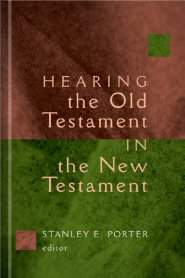
Recently, I have been spiritually growing through the men's study at my church. We started our lesson with the beginning of Jesus' life. Here are some observations from the NT texts presented in the inductive study Lesson 1 at Men of Valor. The five texts included the birth and child narratives of Jesus: Matthew 1:18-25; Luke 2:1-20; Matthew 2:1-12; Luke 2:22-24; Luke 2:40-52. I am not going to include all of them, for there is more references in some texts than others, and that would take forever! Therefore, below are just a few notes on some verses that have a huge OT background or reference (this book, Hearing the Old Testament In the New Testament, is outstanding resource by Stanley E. Porter).
Matthew 1:18-25
A. 1:22-23 is a quotation of Isaiah 7:14, "Therefore the Lord himself will give you a sign. Behold, the virgin shall conceive and bear a son, and shall call his name Immanuel."
B. 1:23 ends with an allusion of Isaiah 8:8, 10 ["Immanuel" and "God is with us"]. Matthew applied these Scriptures to the fulfillment of the coming of Jesus.
Luke 2:1-20
A. 2:9 begins the narrative by (also cf. Matt. 1:20) mentioning the "angel of the Lord." (appears throughout the OT to authenticate a messenger of God; a theophany, especially in relation to Gen. 16:7-11; 22:11, 15; Ex. 3:2; Num. 22:22-35; Jug. 2:1, 4; 5:23; 6:11-22; 13:3-21; 1 Kings 19:7; 2 Kings 1:3, 5; Zech. 12:8).
B. 2:9 describes the glory of the Lord shone around the shepherds just as it did in the OT to confirm the presence of Yahweh. These texts are explicit allusions: Ex. 16 (Pillar Cloud), 24 (Mount Sinai), 40 (Tabernacle); Lev. 9:6, 23 (Priesthood); Ezekiel 43:4-5 (Temple); Isa. 40:5 (Messiah); John 1:14 (Jesus)!
A. 2:2 mentions the "star" that revealed the place Jesus was to be born, but there is no OT references that indicate it was prophesied by God (Jesus is called the bright morning star, cf. Rev. 22:16?)
B. 2:5-6 is a quotation of Micah 5:2 to prophesy where Jesus the Messiah was going to born, "But you, O Bethlehem Ephrathah, who are too little to be among the clans of Judah, from you shall come forth for me one who is to be ruler in Israel, whose coming forth is from of old, from ancient days."
I love studying the OT background of the NT because it highlights and reveals the original purpose of the text. Studying Jesus and the OT fulfillments of his coming in the gospels has made me appreciate this statement in our lesson notes. I came across a verse that encouraged me to study and get in God's Word. Isaiah 34:16 begins with an exhortation, "Seek and read from the book of the Lord!" Therefore, I thought this was a good quote from our study which was relevant to the visible life of Jesus: "God wants us to see him for ourselves [primarily in his Word]. He wants us to be touched by his glory; to witness his majesty; to know him as a friend."
"Whoever says he abides in him ought to walk in the same way in which he walked."
(1 John 2:6)
Luke 2:40-52
A. 2:40 says Jesus become "strong in spirit," and was "filled with wisdom," and "the grace [favor]of God was upon him." These factors are allusions to the Messiah in Isaiah 11:2, "And the Spirit of the Lord shall rest upon him, the Spirit of wisdom and understanding, the Spirit of counsel and might, the Spirit of knowledge and the fear of the Lord." (cf. Isa. 42:1; 61:1-3; Luke 4:16-21)
I love studying the OT background of the NT because it highlights and reveals the original purpose of the text. Studying Jesus and the OT fulfillments of his coming in the gospels has made me appreciate this statement in our lesson notes. I came across a verse that encouraged me to study and get in God's Word. Isaiah 34:16 begins with an exhortation, "Seek and read from the book of the Lord!" Therefore, I thought this was a good quote from our study which was relevant to the visible life of Jesus: "God wants us to see him for ourselves [primarily in his Word]. He wants us to be touched by his glory; to witness his majesty; to know him as a friend."
"Whoever says he abides in him ought to walk in the same way in which he walked."
(1 John 2:6)
Friday, September 7, 2012
Men's Study at Harvest - Introduction

Our first study was very comprehensive and took a long time to finish. Nevertheless, I finished the study and got to contribute to the group time. I was asked to contribute to the group in a deeper, biblical-theological way. It was interesting being ask knowing I have never signed up for the Men' study before, but I was humbled and blessed to able to share. I came to find out it made me dig deeper in the Scriptures and use my hermeneutics that I have been learning. Thus I contribute to the group by sharing OT references, allusions, fulfillments, and insights contained in the various NT texts. On my blog, I am going to post some of those references to share with you some of the cool things that I have been learning about the words and works of Jesus.
"Whoever says he abides in him ought to walk in the same way in which he walked."
(1 John 2:6)
Subscribe to:
Posts (Atom)