Search RJ's Blog

Showing posts with label Justification. Show all posts

Monday, April 22, 2013

Paul, James, and Justification

The traditional debate centers on an apparent soteriological contradiction between the apostles Paul and James. The contradiction is underlined by the teaching of justification taught by Paul (cf. Rom. 2:13; 3:20, 3:24, 3:28; 4:2, 4:25; 5:1, 5:9, 5:16-18; 8:30; 10:30; 1 Cor. 6:11; Gal. 2:15-18, 3:11, 3:24, 5:4; Titus 3:7), compared to the teaching of justification taught by James (cf. James 2:21, 2:24, 2:25). Both Paul and James use the same Greek term for justification, not necessarily contradicting themselves. Even though they use the same terminology, however, they use it differently to showcase their purpose of justification in order to address different contextual situations and circumstances. I think it is easier to understand these alleged contradictions as complementary if seen in a larger and smaller context.

First, look at Paul in a larger perspective. Paul's huge missological function is to preach the gospel as justification to the Gentile world. The biblical narrative explains how Paul encountered Jesus and was commissioned to preach the gospel to the Gentile world. As Paul wrote to churches who were both Jewish and Gentile, all thirteen letters stress significant emphasis on the theological nature of the gospel and it's application. Paul addressed churches [in their respected contexts] about the person and work of Christ, and how Jews and Gentiles are united under the Lordship of Jesus. Hence, Paul wrote about justification to biblically explain the soteriological function of the gospel to those who believed in Christ (i.e. they no longer need to do works, but trust in the work of Christ). Pauline justification focuses on the forensic-judicial nature of justification. Therefore, Paul's emphasis on justification is correctly viewed as extraordinary righteousness in light of the larger context of Paul's purpose in comparison to James.

Second, look at James in a smaller perspective. James is writing one letter "to the twelve tribes in the Dispersion," who are definitely Jewish Christians in need of Christ-centered instruction. James uses vivid contrasts and a rich source of the Jesus tradition in order to reveal to his audience how they are suppose to live in community as the people of God. Thus, James mentions how faith without works cannot satisfy the demands of the gospel because "faith" as intellectual assent cannot produce righteousness. For this reason, James mentions multiple kinds of "works" throughout his letter that inherently speak of biblical fruitfulness and application that produce righteousness. As Schreiner mentions, "James is focused on righteousness expressed by vitrue of the works performed." Therefore, James' emphasis on justification is correctly viewed as ordinary righteousness in light of the smaller context of James' purpose in comparison to Paul.

Concluding that Paul and James do not contradict each other, let me list several reason why they compliment one another: (1) They both mention it is by faith alone one can be made right before God; (2) They both mention it is by faith alone and not works one can be made right before God; (3) They both mention justification is a work of God; (4) They both agree one's relation to God is based on faith and the results of that faith should be evident. This was absolutely an issue for the Jews who wanted to do works to earn a right relationship with God, and for Gentiles who emphasized intellectual assent without works.

Paul and James address a two-sided coin regarding an understanding of Christianity that came out of Judaism, "Not by works but by faith; not just faith, but a faith that shows good works." Paul, James, and justification are summed up wisely by Schreiner, "James responds to antinomianism, whereas Paul reacts to legalism."

Wednesday, April 10, 2013

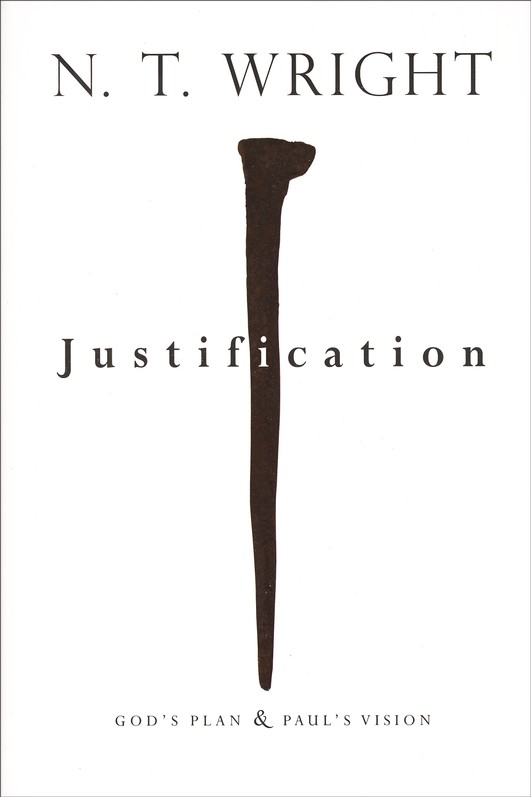
N.T. Wright or Wrong?

It appears in evangelical circles that when people who are familiar with the NPP debate, they think of N.T. Wright almost indefinitely (not necessarily Dunn, Sanders, etc.). Even though I think N.T. Wright is wrong with his NPP in most recent scholarship, his work is very important to evangelical theology and the future perspectives that will emerge so we can defend the tenants of the gospel of grace.

Schreiner notes, "Paul never criticized anyone for the desire to keep God's law; rather, he found fault in the failure to keep it...He found them guilty before God because they failed to keep God's commands...any works in general are clearly in view, and they do not contribute to salvation, for otherwise grace is ruled out and human boasting is allowed" (p.527-528).

Sunday, April 7, 2013

The New Perspective On Paul Diminishes the Atonement

I find the scholarship debate on first century Judaism in Palestine extremely over emphasized and leads to a incorrect perspective on Paul (exactly as Sanders and Dunn incorrectly do). Thus, a wrong view of Paul on the law and gospel inexplicably affects the interpretation of the doctrine of the atonement. I have always lived by this, "We must understand Scripture with Scripture in light of Scripture." It appears this approach carries less of that tone and focuses on an extreme emphasis of religious sensitivity and historicity, and imposing it on to the primary text of Scripture. This extreme emphasis unfortunately invites extreme misplacement, which diminishes the orthodoxy of Paul. The new perspective of Paul diminishes many important creedal-reformational-doctrinal beliefs, but the most striking has to be how it diminishes the atonement of Jesus Christ.

The NPP diminishes the atonement of Jesus Christ in several ways:

1) Sanders and Dunn argue that Paul's main ideological emphasis inherently focused on the Jewish participant in a form of mystical-spirituality with Jesus Christ. Thus, Paul's language (i.e. Scripture) was not judicial language (i.e. justification), but was a subordinate-type to the participate language, basically declaring mystical-spiritual religious life was a way of maintain salvation/sanctification in the first century. This is a covenantal-nomism understanding of the atonement, and deems it unsatisfactory or unnecessary since a relationship with God does not demand a payment of sin but a spiritual reconciliation.

2) N. T. Wright argues that Paul views Israel as only a representative of humanity and taking onto itself the sinfulness of humanity through history culminating in Jesus Christ. This is a kind of historicized-reconstructionism of Paul's Jesus and his understanding of the atonement, and deems it symbolically remedial.

The NPP basically means you can know God without his righteousness that is provided through the atonement of Jesus Christ.

I find it unfortunate and agree with Piper when he explains how the atonement is diminished by the new perspective on Paul, "The faith that justifies continues to hold fast to Christ alone as the ground of our having God as our Father who is completely for us. Whether this right standing with God consists in the imputation of righteousness from beginning to end or consists partly in the impartation of righteousness is a crucial and necessary question [because if answers wrongly, like N.T. Wight, it diminishes the atonement!]."

There is a reason why Paul says, "For we are the circumcision, who worship by the Spirit of God and glory in Christ Jesus and put no confidence in the flesh" (Philippians 3:3 ESV).

What is your favorite subject in Christian Studies?