Search RJ's Blog

Showing posts with label SBTS. Show all posts

Friday, May 3, 2013

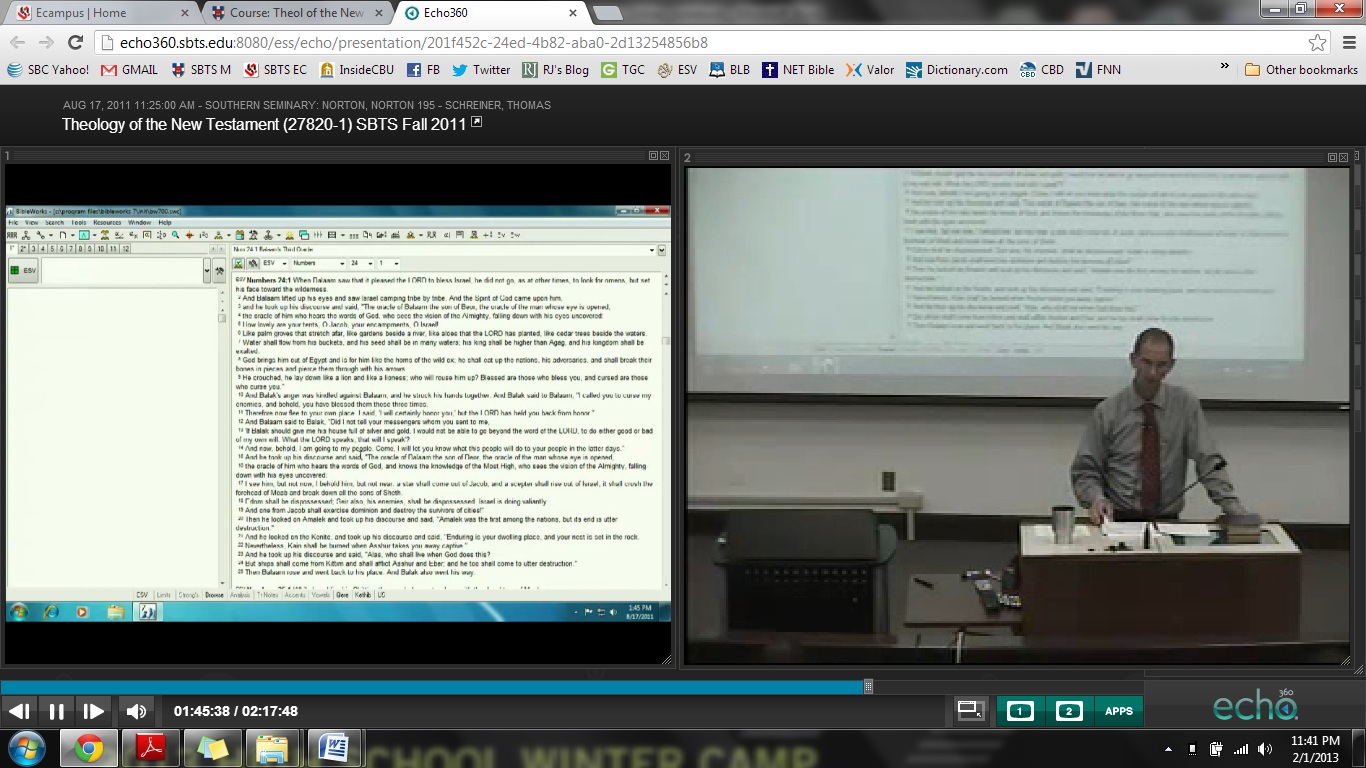
SBTS Online

Going to school online has been very challenging but extremely beneficial. I have been challenged to meet the demands of each class. Yet, I have the flexibility of taking the courses online to manage my schedule throughout each week. Thus, my experience has been pretty awesome. I am impressed with the online Moodle database I use at The Southern Baptist Theological Seminary. Below are some screen shots of the different styles of courses. 


Some classes are in-class lecture videos, and others are more of a personal in-office lecture videos. I really enjoy the personal in-office lecture videos better because they cover more information and move along quickly compared to the extremely long in-class lecture videos. Sometimes the in-class lectures have question periods which make the video very boring and disengaging since you cannot ask a question. The in-office videos, however, are very inductive keeping the student engaged with the content.

If you are looking for a seminary that has the scholarship and evangelical foundations, SBTS is the school you want to attend. A majority of leading theologians and OT/NT scholars all teach at this seminary, so it is worth the investment if you need to go online.

Tuesday, April 23, 2013

Warning Passages In Hebrews

The message of Hebrews is about the greatness of Jesus Christ and how he fulfilled all of God's saving promises through his coming (v. 1:1-3) life (v. 4:15), death and resurrection (v. 9:14; 10:14), and glorious ascension (v. 12:2) as the Son of God.

Chapter 6 is the most important chapter regarding the warning passages in Hebrews. It is in this chapter we learn the reason why the warning passages were written:

"And we desire each one of you to show the same earnestness to have the full assurance of hope until the end, so that you may not be sluggish, but imitators of those who through faith and patience inherit the promises." (Hebrews 6:11-12 ESV)

Why does the Hebrews author write warning passages? To ensure the audience would show the biblical vigor to have the full assurance of the gospel in their hearts and live in obedience to that fundamental NT reality.

These were the problems that lead the author of Hebrews to write warning passages:

"Therefore let us leave the elementary doctrine of Christ and go on to maturity, not laying again a foundation of repentance from dead works and of faith toward God, and of instruction about washings, the laying on of hands, the resurrection of the dead, and eternal judgment." (Hebrews 6:1-2 ESV)

I agree with Schreiner who says, "The importance of obedience and perseverance is woven throughout the letter to the Hebrews, for the readers were tempted to relapse to Jewish practices to avoid discrimination and persecution" (p. 595). The warning passages do not suggest that the readers [who were reverting back to Judaism instead of Christ would] lose their salvation. The warning passages suggest that the readers were being taught with serious Christological-centered instructions describing not go back to the OT ways because Jesus is greater than all.

I find the warning passages very practical and pastoral. They are practical because they are addressing correct way to see Jesus Christ. They are pastoral because they are assisting Christians to live with perseverance and faith during their difficult trials in the first century. Therefore, the challenges by the author of Hebrews carry weighty theological convictions, and must be taken serious. The warnings are figurative and exaggerated parallelism to show the stark contrast between Christ and those who revert back to Judaism.

Monday, April 22, 2013

Paul, James, and Justification

The traditional debate centers on an apparent soteriological contradiction between the apostles Paul and James. The contradiction is underlined by the teaching of justification taught by Paul (cf. Rom. 2:13; 3:20, 3:24, 3:28; 4:2, 4:25; 5:1, 5:9, 5:16-18; 8:30; 10:30; 1 Cor. 6:11; Gal. 2:15-18, 3:11, 3:24, 5:4; Titus 3:7), compared to the teaching of justification taught by James (cf. James 2:21, 2:24, 2:25). Both Paul and James use the same Greek term for justification, not necessarily contradicting themselves. Even though they use the same terminology, however, they use it differently to showcase their purpose of justification in order to address different contextual situations and circumstances. I think it is easier to understand these alleged contradictions as complementary if seen in a larger and smaller context.

First, look at Paul in a larger perspective. Paul's huge missological function is to preach the gospel as justification to the Gentile world. The biblical narrative explains how Paul encountered Jesus and was commissioned to preach the gospel to the Gentile world. As Paul wrote to churches who were both Jewish and Gentile, all thirteen letters stress significant emphasis on the theological nature of the gospel and it's application. Paul addressed churches [in their respected contexts] about the person and work of Christ, and how Jews and Gentiles are united under the Lordship of Jesus. Hence, Paul wrote about justification to biblically explain the soteriological function of the gospel to those who believed in Christ (i.e. they no longer need to do works, but trust in the work of Christ). Pauline justification focuses on the forensic-judicial nature of justification. Therefore, Paul's emphasis on justification is correctly viewed as extraordinary righteousness in light of the larger context of Paul's purpose in comparison to James.

Second, look at James in a smaller perspective. James is writing one letter "to the twelve tribes in the Dispersion," who are definitely Jewish Christians in need of Christ-centered instruction. James uses vivid contrasts and a rich source of the Jesus tradition in order to reveal to his audience how they are suppose to live in community as the people of God. Thus, James mentions how faith without works cannot satisfy the demands of the gospel because "faith" as intellectual assent cannot produce righteousness. For this reason, James mentions multiple kinds of "works" throughout his letter that inherently speak of biblical fruitfulness and application that produce righteousness. As Schreiner mentions, "James is focused on righteousness expressed by vitrue of the works performed." Therefore, James' emphasis on justification is correctly viewed as ordinary righteousness in light of the smaller context of James' purpose in comparison to Paul.

Concluding that Paul and James do not contradict each other, let me list several reason why they compliment one another: (1) They both mention it is by faith alone one can be made right before God; (2) They both mention it is by faith alone and not works one can be made right before God; (3) They both mention justification is a work of God; (4) They both agree one's relation to God is based on faith and the results of that faith should be evident. This was absolutely an issue for the Jews who wanted to do works to earn a right relationship with God, and for Gentiles who emphasized intellectual assent without works.

Paul and James address a two-sided coin regarding an understanding of Christianity that came out of Judaism, "Not by works but by faith; not just faith, but a faith that shows good works." Paul, James, and justification are summed up wisely by Schreiner, "James responds to antinomianism, whereas Paul reacts to legalism."

Wednesday, April 17, 2013

The Servant of the Lord

The Servant of the Lord is a key biblical-theological theme in the book of Isaiah. It is specifically important because Jesus implicitly applies this title to himself multiple times in all four gospels. It was the NT authors who emphasized this theme from Isaiah to be explicitly fulfilled in Jesus Christ.

The OT historical-background regarding the Servant of the Lord was not understood as messianic in function, but was mysterious or symbolic because the intertestamental-period Judaism's interpretation of the Messiah was militaristic not a servant, and in postbiblical-period Judaism there is no evidence identifying these songs as messianic since Christians claimed it.

Hence, first century Christians understood these texts as messianic because they found strong evidence in the life and fulfillment of Jesus Christ as servant [i.e. typology]. Below are the four classic texts regarded as the "Servant Songs" of Isaiah. As Schreiner points out that these passages "are represented by a particular person, one who atones for the sin of the people [i.e. Jesus Christ]."

There are four poetic passages known in the OT as the "Songs of the Servant of Yahweh":
1. First Song: The servant proclaims he is the chosen one and given the Spirit to establish justice (42:1–4).

2. Second Song: The servant reveals and identifies himself as one called by God before birth for the nations (Isa. 49:1-6).

3. Third Song: The servant declares his confidence in God even in the face of oppression and persecution (Isa. 50:4-11).

4. Fourth Song: The servant suffers and dies on behalf of others so they can be healed (Isa. 52:13-53:12).

All four gospels present Jesus as the fulfillment of the Servant Songs and climax in the gospel-centered function of Isaiah 52:13-53:12 (There is a great book that discusses this climatic fulfillment called, The Gospel According to Isaiah 53: Encountering the Suffering Servant In Jewish and Christian Theology by Darrell Bock and Mitch Glaser).

As a result, the Servant Songs in Isaiah identify the Servant of the Lord as a king, prophet, and new Moses. Israel is identified as the children of Abraham, his chose servant (cf. Isa. 41:8-9; 44:1-2; 45:4). God's chosen servant, Israel, fails to see and hear God's word making them flawed and sinful. Thus, the Servant of the Lord suffers and dies for them to forgiven and redeem them from exile (cf. Isa. 44:21-22; 48:20).

These theological realities were not realized until the coming of one like the Son of Man, Jesus Christ. The Servant of the Lord is personified in the person of Jesus Christ, who as servant is both Israel and transcends Israel because he is chosen by God the Father, and fulfills the requirements and commandments given to Israel. Therefore, it is appropriate to say that the "gospel according to Isaiah 53" is displayed by the righteous Servant of the Lord who suffered and died for the sake of transgressors. Amen!
Monday, April 15, 2013

Biblical Theology Discussion: Kingdom Through Covenant vs. God's Glory In Salvation Through Judgment

Here is a great video that discusses biblical theology at The Southern Baptist Theological Seminary. The people in the video are Dr. Gentry, Dr. Wellum, and Dr. Hamilton. They are all biblical scholars and professors at my seminary. It is impressive to know that my professors are putting out sound biblical theology and contributing to the evangelical church a wealth of God-centered literature. In this video, they discuss their most recent published works on biblical theology. Very informative!


Thursday, April 11, 2013

New-Creation Theology In John's Gospel

It is only natural to study Christology and find yourself buried in John's Gospel most of the time. I am taking three NT courses right now at The Southern Baptist Theological Seminary that are all intersecting and overlapping one another on the topic of Christology. I planned this while registering my classes and it has worked out wonderfully. In my NT Theology course with Schreiner, I have gone over Christology in the all the gospels and letters. In Systematic Theology II course with Wellum, I have begun Christology in regards to divine action and providence. My third course is self explanatory, Doctrine of the Person of Christ with Wellum (it is an extensive look into the person of Jesus).

One thing that I have found interesting is the "new-creation theology" in the gospels, specifically John's Gospel. In John, there are many referents to Jesus inaugurating the new-creation (new age) in his coming to fulfill all of God's promises. One of my favorite NT scholars, Andreas Kostenberger, highlights this in The Deity of Christ (Theology In Community) edited by Christopher W. Morgan:
In John's Gospel, the resurrection of Jesus is part of the larger theme of a new creation. At the outset, Jesus is presented as the agent of God's original creation (1:1-3). In keeping with John's creation and new-creation theology, he presents the first week of Jesus' ministry as patterned after the seven days of the original creation (1:19-2:11, including the reference to Jesus' attendance of the wedding at Cana "on the third day" [2:1], which strikes possible overtones anticipating Jesus' resurrection; see 2:19). Possible new-creation language is also found in Jesus' reference to a "new birth" in his conversation with Nicodemus (3:3, 5), and later in the Sabbath controversy (5:17-18). The former passages invoke the prophetic expectation of an end-time renewal and decisive inner transformation in the last days (see, e.g., Isa. 44:3-5; Jer. 31:33-34; Ezek. 11:19-20; 36:25-27; 37), while the latter passage makes the point that, while resting on the seventh day of creation, God [i.e. Jesus] continued to be at work as he chose to act in his sovereignty and providence. Aligning Jesus with the Creator presents his ministry from the very outset against a universal backdrop. Just as creation extended to the entire universe, so also the life given by Jesus is universal in scope, extending not only to the Jews but also to Gentiles. In John's passion narrative, the Gospel's new-creation theology thickens. Possible instances of the new-creation motif include the following: 
1. The setting of the passion narrative in a garden, invoking the memory of Eden (18:1, 26; 19:41) 
2. Pilate's identification of Jesus as "the man" (19:5), which may present Jesus as the new Adam 
3. The possible portrayal of Jesus' resurrection as the beginning of a new creation (1:3; 20:1) 
4. The identification of Jesus as "the gardener" by Mary (20:15), reflecting misunderstanding and possible also irony 
5. Jesus' bodily resurrection and resurrection appearances to his followers in keeping with repeated earlier predictions in the narrative (2:20-21; 10:17-19; 20) 
6. Jesus' breathing on his disciples and his giving of the Spirit in the final commissioning scene (20:22), invoking the creation of Adam in Genesis 2:7 (Ezek. 37:9)
I love these insights! I have a lot to think about when it comes to "new-creation theology" promised in the OT and realized in the NT. There are so many OT and NT connections that I am seeing for the first time. Jesus inaugurated the new-creation by doing might deeds that no one has ever seen before. Jesus fulfilled all of the new-creation promises of God in the OT and made them a realized. Today, the gospel message is being preached in the already-not-yet bring about transformation of sinners into new-creation (cf. 2 Cor. 5:17). Nevertheless, on the day when Christ returns, the new-creation will be consummated and all things will be made new and restored back to their Edenic state of paradise. Eden to Eden, garden to garden, temple to temple, but with Jesus as the center of new-creation (see Revelation 21-22). Amen!

Wednesday, April 10, 2013

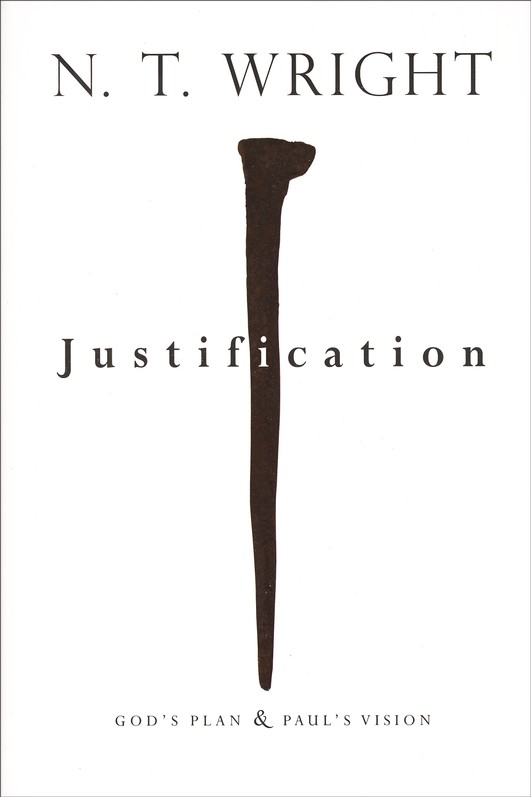
N.T. Wright or Wrong?

It appears in evangelical circles that when people who are familiar with the NPP debate, they think of N.T. Wright almost indefinitely (not necessarily Dunn, Sanders, etc.). Even though I think N.T. Wright is wrong with his NPP in most recent scholarship, his work is very important to evangelical theology and the future perspectives that will emerge so we can defend the tenants of the gospel of grace.

Schreiner notes, "Paul never criticized anyone for the desire to keep God's law; rather, he found fault in the failure to keep it...He found them guilty before God because they failed to keep God's commands...any works in general are clearly in view, and they do not contribute to salvation, for otherwise grace is ruled out and human boasting is allowed" (p.527-528).

Tuesday, April 9, 2013

G.K. Beale: New Studies In the Old & New Testaments

If you want to learn about biblical theology of the OT and NT in depth, then biblical scholar G.K. Beale is the guy you want to read. I have two of his largest works (both books in the picture on the left). Contained inside these two recent volumes are biblical theology and exegesis in its finest form. It is remarkable how much this man knows about the Bible, and the connections he has discovered through relentless research. He has definitely advanced the future discussions and academic interests regarding the usage of the OT in the NT. All Christians are in debt to him for his work to establish the correct theological interpretations of the redemptive-historical narrative of the Bible, and how that needs to be taught in churches because it is the gospel.

I have learned that it is that meta-narrative (i.e. redemptive-historical storyline) that the Apostles' preached, the Reformers proclaimed, and the Revivalists programmed into their church ministries. In the recent resurgence of biblical theology, Mark Dever has mentioned teaching biblical theology as the second mark of a health church in his book "Nine Marks of a Healthy Church." Hence, I personally agree with Dever that a healthy Christ-centered church will teach biblical theology undiminished  I believe biblical theology is too important to ignore and must be taught in order to properly understand how the Bible unfolds and interconnects with diversity and unity throughout the canonical books from Genesis to Revelation.

Below is a link to a remarkable lecture hosted at my seminary, The Southern Baptist Theological Seminary. This lecture emphasizes the challenges in biblical theology that are confronting the integrity and inspiration of the Scriptures. Some scholars are doing injustice to biblical theology and emphasizing only the thematic elements of the Bible, not the authoritative verbal-plenary inspiration of Scripture. The lecture is very informative, and if you have not heard an academic lecture on Christian theology before, this exposure will be riveting and exciting because of the biblical connections that are identified in biblical theology that are not necessarily emphasized on the pulpit. Click on the link below to watch and listen an this lecture regarding new studies in the OT and NT biblical theology.

http://www.sbts.edu/resources/lectures/gheens/recent-developments-in-old-testament-in-new-testament-studies-that-challenges-the-organic-integrity-of-the-testaments/

Monday, April 8, 2013

Fulfillment Formulae In Matthew's Gospel

In the Gospel of Matthew, there is specific theme of "fulfillment" where the author uses OT texts to prove Jesus is the Messiah. This is know has the "fulfillment formulae" of Matthew. The formulae teaches us two things about the Lord. First, God's saving promises in the OT are being fulfilled. Second, God's saving promises in the OT are being fulfilled in the person of Jesus Christ. Schreiner points out how "the fulfillment theme in Matthew demonstrates that OT prophecy anticipated and pointed towards Jesus." The various Scriptures that Matthew quotes teach us that Jesus is the new King (Matt. 2:1-6), the true Israel (Matt. 2:13-15), the new exodus (Matt. 2:16-18; 4:1-11), and the new covenant (Matt.4:14-16). Jesus ultimately fulfills the Scriptures at his baptism when the Holy Spirit descends upon him to "fulfill all righteousness" and identify him as the Servant of the Lord in the OT who came to suffer and die for the sins of his own people (cf. Matt. 3:15; 8:14-17; 12:18-21; 21:5-6; 26:50-56).

The emphasis on fulfillment in Matthew is important to understand because the author was writing to Jewish Christians who were still trying to live in old law of Judaism and not in the new law of Christ. The defining words by Jesus in the Sermon on the Mount is the most profound fulfillment formulae usage that is not quoting an OT text to substantiate the claim, "Do not think that I have come to abolish the Law or the Prophets; I have not come to abolish them but to fulfill them. For truly, I say to you, until heaven and earth pass away, not an iota, not a dot, will pass from the Law until all is accomplished" (Matt. 5:17-18). Even thought these two verse to not mention an OT text, they do encapsulate the idea that Jesus came to fulfill the Scriptures because they were always intended for him to accomplish and bring salvation to his people because man could never fulfill and accomplish the law.

The fulfillment formulae reveals how God's saving plans are realized in Jesus Christ. Thus, Matthew's Gospel ranges from Abraham to David, to all of the Law and the Prophets, to showcase how Jesus' birth-life-death-resurrection was not an accident, but was the promised-plan from the beginning. Indeed, the fulfillment formulae displays the inauguration of God's saving purposes that was proclaimed and prophesied from the beginning in order to confirm his messiahship who will consummate all things in the end.

Sunday, April 7, 2013

The New Perspective On Paul Diminishes the Atonement

I find the scholarship debate on first century Judaism in Palestine extremely over emphasized and leads to a incorrect perspective on Paul (exactly as Sanders and Dunn incorrectly do). Thus, a wrong view of Paul on the law and gospel inexplicably affects the interpretation of the doctrine of the atonement. I have always lived by this, "We must understand Scripture with Scripture in light of Scripture." It appears this approach carries less of that tone and focuses on an extreme emphasis of religious sensitivity and historicity, and imposing it on to the primary text of Scripture. This extreme emphasis unfortunately invites extreme misplacement, which diminishes the orthodoxy of Paul. The new perspective of Paul diminishes many important creedal-reformational-doctrinal beliefs, but the most striking has to be how it diminishes the atonement of Jesus Christ.

The NPP diminishes the atonement of Jesus Christ in several ways:

1) Sanders and Dunn argue that Paul's main ideological emphasis inherently focused on the Jewish participant in a form of mystical-spirituality with Jesus Christ. Thus, Paul's language (i.e. Scripture) was not judicial language (i.e. justification), but was a subordinate-type to the participate language, basically declaring mystical-spiritual religious life was a way of maintain salvation/sanctification in the first century. This is a covenantal-nomism understanding of the atonement, and deems it unsatisfactory or unnecessary since a relationship with God does not demand a payment of sin but a spiritual reconciliation.

2) N. T. Wright argues that Paul views Israel as only a representative of humanity and taking onto itself the sinfulness of humanity through history culminating in Jesus Christ. This is a kind of historicized-reconstructionism of Paul's Jesus and his understanding of the atonement, and deems it symbolically remedial.

The NPP basically means you can know God without his righteousness that is provided through the atonement of Jesus Christ.

I find it unfortunate and agree with Piper when he explains how the atonement is diminished by the new perspective on Paul, "The faith that justifies continues to hold fast to Christ alone as the ground of our having God as our Father who is completely for us. Whether this right standing with God consists in the imputation of righteousness from beginning to end or consists partly in the impartation of righteousness is a crucial and necessary question [because if answers wrongly, like N.T. Wight, it diminishes the atonement!]."

There is a reason why Paul says, "For we are the circumcision, who worship by the Spirit of God and glory in Christ Jesus and put no confidence in the flesh" (Philippians 3:3 ESV).

Saturday, April 6, 2013

Pre-existence of the Son of God

In my NT theology class we discussed the centrality of Christ in the Synoptic Gospels. One of the key doctrines that is emphasized in Matthew, Mark, and Luke is the pre-existence purpose statement formula of Jesus, "I have come." Not many people talk about the pre-existence of Christ outside of the Christo-centric nature of John. Simon Gathercole has written a great book on the pre-existence of Jesus called, "The Preexistent Son: Recovering the Christologies of Matthew, Mark, and Luke," and argues that there are three sayings in the Synoptics that relate particularly to the coming of Jesus in regards to his pre-existent nature as God.

First, Jesus has two occasions where he faces demons and they ask if he "has come" to destroy them (cf. Matt. 8:29; Mark 1:24; 5:7; Luke 8:28). This presupposes that Jesus existed beforehand with authority as God.

Second, Jesus has six sayings where he declares why he "has come" into the world: to preach the gospel of kingdom, to call sinners to repentance, to fulfill the law and prophets, to cast judgement, to bring a sword, and to bring division among families (cf. Matt. 5:17; 9:13; 10:34-35; Luke 12:49). These reasons are all rooted in the activity of God in the OT (cf. Josh. 5:13-14; 1 Chron. 21:16), especially Luke 12:49 when Jesus says he will cast fire down on earth (cf. Gen. 19:24; Ex. 9:23; 2 Kings 1:10-12).

Third, Jesus uses the same theological title two times to articulate why he "has come" as Son of Man (Matt. 20:28; Luke 19:10). All of these "I have come" sayings according to Schreiner mean, "The purpose of Jesus' coming, implying that Jesus comes from outside the human sphere for a mission upon earth, which in turns suggests that his origin hails from outside the sphere of humanity." The Son of Man references are directly linked to Daniel 7 and suggest Jesus is like the "Ancient of Days" who is indeed God. All of these "I have come" statements are found in the OT by angelic visitors to God's people as well (cf. Dan. 9:22-23; 10:12, 14, 20). Therefore, they all point to Jesus Christ as the co-equal of the Father and display his pre-existence.

In Matthew 23:34-36, Jesus' pre-existence as the Son of God is fully disclosed. Jesus says he has sent the prophets just as God did in the OT. The OT clearly teaches God sent the prophets to his people. Gathercole notes for Jesus to say that "he sends the prophets" absolutely aligns him with Yahweh rather than with other human beings [prophets & wisdom teachers]. Schreiner mentions that there is no biblical or extra-biblical literature that mentions a prophet or wisdom teacher that claims such deity (i.e. pre-existence). This is pretty good internal evidence to support that Jesus is the pre-existent Son of God!

Wednesday, April 3, 2013

Creeds and Scripture: The Deity of Christ

To maintain a biblical Christology that is timeless and evangelical, Stephen Nichols states one must submit to tradition (Creeds) and text (Scripture) in the book, The Deity of Christ edited by Christopher W. Morgan. Submission to tradition means to adhere to the christological creeds of the early church such as the Nicene and Chalcedon creeds. Submission to text means to adhere to the Scriptures alone as the ultimate authoritative source for a biblical Christology. The historical Jesus is grounded in historical realities based on the Bible. Thus, submitting to traditions regarding Christological creeds is submitting to Scripture in once sense.

Submission to Tradition
The creeds of the early church fathers teach us the correct interpretation of Jesus and how we should submit to their framework in order to not error in heretical doctrine. Nicene teaches us that Jesus is equal with God "of one or of the same substance" (regarding his trinitarian relationship). Chalcedon teaches us that Jesus is "fully God and fully human, and that those two natures conjoin perfectly and fully in one person" (regarding the identity of Christ). Both of these creeds do not cancel each other out but rather compliment each other because they do not overemphasize the deity of Christ or the humanity of Christ. These creeds both uphold the same things but address different heresies of their day. They both uphold the divinity of Jesus without rejecting his humanity, and uphold his humanity without rejecting his divinity as the Son of Man. Therefore, tradition teaches us we should honor the Lord Jesus in this respect and know him through a confessional-creedal tradition that was supported by the earliest believers in Christianity instead of trying to figure out the identity of Jesus.

Submission to Text
The text of Scripture compiles the ultimate and authoritative source revealing who is Jesus Christ. The Scriptures teach us everything we need to know about Jesus Christ because all of Scripture testifies of him. "We should only go to the Jesus of sacred Scripture, God incarnate, who lived and died and rose again and is now seated in power at the Father's right hand. We need to be reminded that we are required to submit to the whole counsel of God." It is in Scripture we learned about Jesus and how he is our great God and savior. Therefore, we must trust and obey what the Bible reveals to us about the identity of Jesus and proclaim that message to the  nations.

Tuesday, April 2, 2013

Dr. Wellum @ SBTS

I am truly blessed as a seminary student at The Southern Baptist Theological Seminary. One of my professors, Stephen Wellum, is one of the leading systematic theologians in evangelicalism. I am impressed by the amount of biblical information this man of God knows, but even more impressed by how he communicates theological matters and always brings everything back to the centrality of the gospel.  Every class begins with prayer and ends with prayer. He comes off incredibly smart and humble in my class lectures and interactions (especially if you do not agree with him on something, he explains things very gracefully and responds systematically). I hope to meet him this summer on campus at SBTS and share with him the things I have been learning.

I have two courses with Dr. Wellum this Spring semester, and because of these classes so far, my theological and hermeneutical understandings have developed significantly. I guess this blog entry is a kind of tribute because he has contributed to my theological formation. Thanks for being a great teacher, Dr. Wellum!

He has required the most reading I have ever had in school so far (10 of my 12 books are required for his classes among my three courses). The reason why Dr. Wellum provides all of the reading is to challenge students so they can develop a comprehensive and objective understanding of topical information (i.e. God, Christ, Scripture, etc). I have definitely achieved that goal. With the all of the required reading comes his passionate lectures. If you ever hear him teach, it is clear that he cares deeply about the primary text, i.e. Word of God, and desires to glorify Jesus. Both of my courses discuss the person and work of Christ, and as a result have learned many great things about the Lord.

I found out that his "Jesus courses" are going to be summed up into a magisterial writing in the theology series, Foundations of Evangelical Theology. I am looking forward to his new book to come out next year and have him possibly sign it at ETS San Diego in 2014. It will be the leading Christian theology book on Jesus Christ for sure, which is my favorite subject! It's all about Jesus, and that's why I enjoy Dr. Wellum's courses so much.

Monday, April 1, 2013

Deity of Christ - Theology In Community

My former dean at California Baptist University, Christopher W. Morgan, began a theology series several years ago that emphasize important topics in Christian theology. You can see all of his books here. One of his books I am reading in my course, The Doctrine of the Person of Christ, with Stephen Wellum from The Southern Baptist Theological Seminary. Wellum has two significant chapters in this book that make very good points and contribute to the overall thesis of the entire work.

I have found this book as one of the essentials regarding Christology from a retrospective-American interpretation because the identity of Jesus Christ has become misunderstood over the past hundred years in the west.

One of my favorite things about The Deity of Christ is how it is written with great intertextuality, meaning each essay is harmoniously rooted in the Scriptures, which provide the main authoritative source for a proper identification of Jesus Christ. The essays vividly express the correct biblical identity of Jesus Christ by looking back at the past and current interpretations, while diving into exegesis of the OT and NT primary texts about Jesus as the Messiah and King. There is also an apologetical element to the book that discusses the different versions of Jesus among cults and other religions, and ends with a missiological understanding of gospel proclamation grounded in the deity of Christ.

Saturday, March 30, 2013

The Sovereignty of Jesus Christ In John's Gospel


As a Christian, there is no greater affirmation than understanding God is in control of all things as the sovereign Lord of creation like in Psalm 24:1, "The earth is the LORD's and the fullness thereof, the world and those who dwell therein." Everything was made by him and therefore everything is his and under his control. Reading outside the miracles and might deeds of Jesus that disclose his sovereignty, I have noticed the teachings of Jesus that emphasize his divine sovereignty over salvation.

In John's Gospel, Jesus is seen as God from beginning of John in the creation motif (1:1-3), and at his resurrection appearance  towards the end (20:17). Yet, it is in John 5 where the gospel explains the sovereignty of Jesus Christ most explicitly:

Jesus claims deity:
"This was why the Jews were seeking all the more to kill him, because not only was he breaking the Sabbath, but he was even calling God his own Father, making himself equal with God." (John 5:18 ESV)

Jesus explains deity:
"So Jesus said to them, “Truly, truly, I say to you, the Son can do nothing of his own accord, but only what he sees the Father doing. For whatever the Father does, that the Son does likewise." (John 5:19 ESV)

Jesus proclaims sovereignty:
"For as the Father raises the dead and gives them life, so also the Son gives life to whom he will." (John 5:21 ESV)

Jesus heralds sovereignty-rule:
"For as the Father has life in himself, so he has granted the Son also to have life in himself. And he has given him authority to execute judgment, because he is the Son of Man." (John 5:26-27 ESV)

Jesus applies Scriptural authority:
"But the testimony that I have is greater than that of John. For the works that the Father has given me to accomplish, the very works that I am doing, bear witness about me that the Father has sent me. And the Father who sent me has himself borne witness about me. His voice you have never heard, his form you have never seen, and you do not have his word abiding in you, for you do not believe the one whom he has sent. You search the Scriptures because you think that in them you have eternal life; and it is they that bear witness about me." (John 5:36-39 ESV)

Jesus confirms deity:
"For if you believed Moses, you would believe me; for he wrote of me." (John 5:46 ESV)

These verse all substantiate the sovereignty of Jesus Christ in John's Gospel by testifying to the divine-type identity of the Son of Man. From these verses, the context of chapter 6 makes even more sense:

Jesus validates his sovereignty:
"Jesus answered them, 'Do not grumble among yourselves. No one can come to me unless the Father who sent me draws him. And I will raise him up on the last day. It is written in the Prophets, ‘And they will all be taught by God.’ Everyone who has heard and learned from the Father comes to me—not that anyone has seen the Father except he who is from God; he has seen the Father. Truly, truly, I say to you, whoever believes has eternal life." (John 6:43-47 ESV)

In just these short verses, John's Gospel suggests that Jesus is the sovereign Lord over salvation. Only through Jesus Christ can someone have eternal life. Believing in him is under the vice regency of his Lordship (divine sovereignty). Those who believe are called, drawn, and brought to him to assure and secure their salvation in the God-Man, Jesus Christ.

Friday, March 15, 2013

The "Belief Motif" In John


How does someone believe in John's gospel? Is it only as simple as believing in Jesus Christ as Lord and God (cf. John 20:28)? Is there more of a dynamism of belief? How is this explained only within the context of the gospel of John? In John's gospel, Jesus teaches about belief by using sixteen with different terms such as, "receive, obey, drink, hear, come, behold, eat, enter, abide, go, know, follow, hating, love, keep, knowing." It is clear that there is a philosophical dynamism that seek to explain the new kingdom phenomena of faith and obedience based on "belief" in the Messiah Jesus. In John, the dynamism of "belief" is not just having knowledge of someone or something, but it is believing with transforming faith and obedience that is radically different from all other forms of belief. John makes it clear that salvation is grounded in responding correctly to Jesus' command, "believe in me" (cf. 1:7, 50; 3:12, 18; 4:21, 42, 48; 5:38, 44, 46, 47; 6:29, 30, 36, 64; 8:24, 45, 46; 9:18; 9:35; 38; 10:25, 26, 37, 38; 11:15, 26, 27, 42, 48; 12:36, 37, 39; 13:19; 14:1, 10, 11, 29; 16:9, 30, 31; 17:20, 21; 19:35; 20:25, 27, 31).

If you survey John's Gospel, I think the biblical data appropriately defines the necessary grounds for "belief" in John as believing in Jesus Christ as the Messiah, Lamb of God, Son of God, Son of Man, I AM, and the Logos. Throughout John, the theme of believing occurs approximately ninety-three times, clearly indicating an important motif due to its repetitive nature. Yet, the repetitive nature is not autonomous, but always is in conjunction to psychosomatic unity [i.e. heart and mind] of knowing the true identity of Jesus Christ that is followed up with transforming faith and obedience. Therefore, to belief in this new way is a summation to essentially encounter-experience-follow-and-obey the Lord Jesus Christ.

To understand "belief" in John, the key is to follow the literary structure. Viewing the beginning of John as a stage presenting the first act of a threefold story about believing in Jesus Christ is the critical, followed by a second act and finale (i.e. Introduction [who is Jesus], Body [events revealing who is Jesus], Conclusion [purpose to know who is Jesus]). 

John 1:1-51, the introduction reveals the emphasis of belief in John.
John 2:1-20:29, the body explains the dynamism of belief in John.
John 20:30-21:25, the conclusion reveals the purpose of belief in John.

Most scholars believe it is possible to develop all of the themes in John solely out of the first chapter alone, and it is not surprising that the "belief" motif starts in that section.


Beginning in the first chapter of John, we see the genesis of the "belief motif" in John 1:7, "He came as a witness, to bear witness about the light, that all might believe through him." Structurally placed between the first usage of believe and the beginning of prologue and first pericope (v.1:1-51), John records the identity of the light as Jesus Christ (vv. 1:4, 5, 8, 9), and affirms the progressive evangelistic nature of believing in Jesus Christ through the witnesses who testified and followed him (vv. 1:37, 40, 43). The first chapter ends with Jesus asking if those following him believe in John 1:50, "Jesus answered him, Because I said to you, ‘I saw you under the fig tree,’ do you believe? You will see greater things than these.” The concluding statement issues an important question that is presented to all of the characters throughout the rest of the gospel, "Do you believe?" The evangelist begins his gospel by introducing a thematic emphasis for his letter, "Do you believe in Jesus Christ? If not, read about the Son of God in the next few chapters, and I will ask you this question again at the end of my gospel to see if you believe" [italics are mine]. 

After the introduction, the body of the gospel consists of Jesus explaining the dynamism of "belief" and why someone must believe in him (vv.2:1-20:29). Notice the last verse concluding the life, ministry, death, and resurrection of the Son of God in John 20:29, "Jesus said to him, 'Have you believed because you have seen me? Blessed are those who have not seen and yet have believed.'” John wraps up the story with a defining statement by Jesus Christ. John returns to the "belief motif" to set up his conclusion and purpose.

The conclusion of the gospel ends with a purpose statement and unique event which points back to the emphasis of the statement (vv. 20:30-21:25). The conclusion of the gospel reveals the purpose and reason for the emphasis of "belief" in John 20:30-31,
"Now Jesus did many other signs in the presence of the disciples, which are not written in this book; but these are written so that you may believe that Jesus is the Christ, the Son of God, and that by believing you may have life in his name."
This purpose statement concludes the reason why John wrote his gospel, "That by believing you may have life in his name" [italics are mine]. As John begins his gospel with the "belief motif" he concludes with it. Following the purpose statement is a unique event that confirms Jesus as the resurrected Lord and God. In these short resurrection appearances, the"belief motif" is only enhanced by more evidence to convince the reader to believe in the Messiah Jesus.

John does a great job of explaining throughout his gospel what it means to believe in a dynamic way. The Jews believed, but they did not believe God's Word correctly. The Greeks believed, but they did not believe in God correctly. Believing in something that is truth and corresponds to reality is the key in John's gospel because Jesus proves he is the truth over and over again with salivific implications. Therefore, when we tell people to believe in Jesus Christ, we must teach what it really means to believe in him by sharing the entire gospel message!

Monday, March 11, 2013

The Role of Tongues In Acts


Regarding the nature of the gift of tongues in Acts, it is first and foremost established as a unique gifting of God through the Holy Spirit to the apostles so they could proclaim the gospel of Jesus Christ and herald his identity as the exalted and resurrected Lord in the new age of redemptive history. Therefore, I would suggest a biblical interpretation, usage, and role of the unique gifting of tongues in Acts is grounded in gospel proclamation.

Later in Acts, the unique gifting of tongues is given to other believers as well, further explaining how someone receives the gift of tongues from the same Spirit, and must be a born-again regenerate Christian in the exalted and resurrected Lord, Jesus Christ. 

The "Pentecost motif" continues three times in Acts, which establishes a significant biblical pattern for speaking in tongues with regards to being grounded in gospel proclamation (cf. [Jewish Pentecost] vv. 2:3, 4, 11: [Gentile Pentecost] v.10:46; [Johannine Pentecost] v.19:6). It is not just the Jewish people who receive the Spirit [which was an eschatological promise of God (Ezekiel 36), but that eschatological promise is also for the Gentiles [all nations] (10:44ff). Hence, God the Holy Spirit appears to gives the unique gifting of tongues in Acts to proclaim gospel-centered truth (i.e. preaching things of gospel, and having fellowship which cultivates "koinonia" [the things of God] among the people of God vv. 2:42-47).

I believe the distinct role of tongues in Acts is clearly a reversal of the confusion/scattering of the tongues in Genesis 11 (the tower of Babel). Due to the disobedience of the old Adam image-bearers in Genesis 11, God scatters them into different nations and confused their tongues. Yet in Acts 2, those who believe in the obedience of the New Adam, Jesus Christ, God gathers them into a new spiritual nation and unifies them through the gospel.

The word "tongues" means, "1) the tongue, a member of the body, an organ of speech 2) a tongue 1a) the language or dialect used by a particular people distinct from that of other nations of uncertain affinity; the tongue; by implication, a language (specially, one naturally unacquired)" (Strong's). If Babel parallelism is true, then it is appropriate to translate and understand tongues as languages or dialects of nations ("native tongues" cf. vv. 2:5-8). Thus, Acts is doing a play-on-words of tongues as a reversal of having a different language in Genesis 11 (which is confusion), compared to the language of the gospel in Jesus Christ (which is truth)! 

Every instance in Acts, the mention of tongues follows these biblical characteristics  receiving salvation [became a new creation] (2:37-47); extolling God [celebratory worship] (10:46), and prophesying [preaching the truth] (19:6). The role of tongues in Acts show the progression of the gospel to all nations through the three "Pentecost motif" events which are gospel-centered proclamation episodes in the narrative, and as a result are saturated in biblical characteristics which glorifying God.

(NOTE: Paul's letters definitely define the use and purpose of tongues directly, and that is why I mention the term "unique gifting of God" in regards to the gift of tongues. I believe my analysis of Acts can be true of Paul as well, but in a different context of course (i.e. ecclesiological issues). No where else do we read in the NT that this unique gift of tongues was used to speak in mysterious languages or utterances to signal a divine revelation or word from God. The use of tongues within the Lukan account is grounded in the proclamation of the gospel, and I think Paul was hinting the same in the his exposition of the misuse of tongues (1 Cor. 14). The confusing nature of the unique gifting of tongues is when Paul speaks of this gift as one of the spiritual gifts the Holy Spirit gives to believers. Yet, Paul only mentions the Spirit gives the unique gift of tongues to equip and edify the church, not endorse or empower yourself. It is a mysterious topic indeed, so I rest in this: God is in control and can use anyone he chooses to speak his truth!)

Friday, March 8, 2013

"Belief" In John's Gospel

The significance of believing in John's gospel is grounded in the fulfillment of the purpose of the gospel in John 20:30-31, "Now Jesus did many other signs in the presence of the disciples, which are not written in this book; but these are written so that you may believe that Jesus is the Christ, the Son of God, and that by believing you may have life in his name." In other words, believing in the unrivaled testimony of the Son of God, Jesus Christ, is the prerogative for John's mission and purpose in his gospel. John the evangelist writes for many to believe unto salvation in the Messiah.

The importance of "belief" in John's gospel is supported by the biblical data where the terminology occurs 98 times. Belief in John's gospel, however, carries "irony" towards belief that is thematically and theologically woven in the narrative and linked to the signs of Jesus (e.g. Jesus does signs to believe in him; Jews see signs and do not believe in him, [cf. John 1:11]).

John records the "signs" of Jesus to reveal his deity and manifest his glory, as in John 2:11, "This, the first of his signs, Jesus did at Cana in Galilee, and manifested his glory. And his disciples believed in him." The term "signs" are repeatedly used in John and wrapped up in the context of belief (cf. 2:23; 3:2; 4:48; 6:2, 26; 7:31; 9:16; 11:47 [12:37; 20:30]). However, the "irony of belief" is defined by the Jews rejecting Jesus in John 12:37, "Though he had done so many signs before them, they still did 'not believe' in him." This verse really points to the bigger theological meaning of "belief" in John. The Jews misunderstood the signs of Jesus, and as a result did not believe in him as the Messiah. The outcasts, however, understood the signs of Jesus, and as a result believed in him just as recorded in John 6:14, "When the people saw the sign that he had done, they said, “This is indeed the Prophet who is to come into the world!"For this reason, it is appropriate to suggest the "irony of belief" in John's gospel is fundamentally grounded in the biblical data which points to believing in Jesus as Messiah as the most superior determination according the gospel narrative.

Wednesday, March 6, 2013

Fabricating Jesus: How Modern Scholars Distort the Gospels

One of the books I needed to read for my Christology course at SBTS was very compelling and apologetically inclined. The name of the book is called, Fabricating Jesus: How Modern Scholars Distort the Gospels, by Craig Evans. This book and its content is definitely valuable to the Christian faith because it proves historicity and authenticity of the person of Jesus Christ, and the trustworthiness of Scripture (especially the New Testament). The book goes over the various misinterpretations and explores the illogical conclusions of modern scholars who intentionally slander, mock, and use dishonest scholarship and intellectual bias in order to dethrone a biblical Jesus Christ in the modern world. I find these illogical conclusions as very dangerous and destructive because they distort the true identity of the biblical Jesus.

Evans provides six things believers can do to authenticate their beliefs as reasonable and true:
1. Historical Coherence - The historical circumstances in the Gospels are authenticated by the life and ministry of Jesus in real history because he claimed historical-theological realities that were true in that age.

2. Multiple Attestations - The historical accounts of the Gospels and other sources that attest to the same realities and existence of Jesus suggest the Gospels are reliable sources with historical importance.

3. Embarrassment - The historical material in the Gospels speak of characters in the narrative that would not be placed in a fabricated story because the narratives report accurate and real reports/witness of what transpired.

4. Dissimilarity - The historical continuity and harmony of the fourfold Gospels all promote the same theological and ethical teaches of Jesus and do not suggest they were invented but rather original.

5. Semitisms and Palestinian Background - The historical context of the Gospels utilize the original languages, imply the readers to know cultural traditions of the first century, and mention many historical-geographical locations that are archaeological preserved to show evidence of the trustworthiness of the Scriptures.

6. Consistency (coherence) - The historical data of the Gospels in the previous five points dismiss skepticism and place Christianity on a pillar of reason and truth through a consistent burden of proof about the person of Jesus and the truth of Scripture.

The biblical "portrait" of Jesus and the "perspective" Gospels will always be distorted if such criterion is rejected and not methodologically and scholastically analyzed as all other ancient historical-religious documents.

It is important to herald the biblical Jesus and point out the illogical conclusions of these dishonest scholars who are influencing many students to believe in false interpretations of the Savior and the Scriptures. To do this, Evans suggest we should give a reason for our biblical beliefs about Jesus and the Word of God. Since dishonest scholars do not give any principle of sufficient reason, their arguments are very intimidating yet extremely weak. It appears they just attack the doctrines of Christianity as a bully pushes someone smaller around to make them appear bigger and stronger. The bully, however, when challenged with the same display of authority appears weak and recognizes his bullying tactics are weak and defeated.

In the same sense, Christians need to stand up to such scholarly bullying per se. All believers should stand up with intelligence, reason, and biblical data to support beliefs against anyone who questions the Christian faith. Christians can give a response with a principle of sufficient reason to point to the reality of truth in Christ. All things in Scripture should correspond with reality, and it is no surprise that Scripture is grounded in that criterion.

Saturday, March 2, 2013

The "I am" of the Old Testament In the New Testament


Since the day I became a Christian, the perplexing "I am" statements of Jesus in John’s gospel have always interested me. I always had a hard time trying to understand what Jesus meant by his unique references, but I knew without a shadow of a doubt he was referencing he was in some way he was “God in the flesh” (cf. John 1:18). 

As I grew stronger in the grace and knowledge of the Lord Jesus Christ, I began to understand the theological significance of the claims of Christ. I understood the “I am” statements to reference Jesus as the all satisfying providential caregiver for all who believe in him, and only through faith in his gospel can anyone be saved.


Once I started Bible teaching on a regular basis at my church and later went to school to be educated in the Scriptures, I began studying the topic of the "I am" statements from an exegetical and canonical approach. As a result, I was exposed to the massive context of references in the OT. It became apparent that Jesus used the OT references and applied them to himself because he is God in the flesh, the self-revelation of God the Father. 

The "I am" of the Old Testament In the New Testament
All of the “I am” statements fundamentally teach us what Jesus does for those who believe in him. Yet, the purpose of the “I am” statements is to teach us who Jesus is in the gospel of John.

In John’s gospel, there are multiple “I am” sayings. For sake of clarity, distinguishing them into two categories helps constructive interpretation and minimizes confusion. For that reason, John’s gospel reveals there are primary “I am” statements, and secondary “I am” sayings. Categorizing does not in any way minimize the importance of the sayings because all of them are equal in significance, meaning, and purpose. The statements are theological and exegetical referents to OT themes (i.e. bread/light/door/shepherd/vine). The sayings are biblical referents to OT titles of God (i.e. Pentateuch/Isaiah passages). There are seven primary "I am" statements, and seven secondary "I am" sayings in John. Nevertheless, both the “I am” statements and “I am” sayings directly reference OT theological titles and themes in the Pentateuch, and servant-oriented messianic functions in Isaiah to showcase a glorious literary rendering of the promises of God fulfilled in the Messiah Jesus.

The "I am" Revealed In the Pentateuch
Genesis is where the "I am" is revealed as the creator of the heavens and the earth, and the covenant maker with Abraham for all nations. Beginning with the John 8:58 "I am" reference in John's gospel, the theological titles in Pentateuch begin with God speaking to Abraham as his “I am.” Thus, God is the “I am” to Abraham and his sons in throughout the patriarchal narrative in Genesis:

Genesis 15:1, "I am your shield; your reward shall be very great.”

Genesis 15:7, “I am the Lord who brought you out from Ur of the Chaldeans to give you this land to possess."

Genesis 17:1-2, “I am God Almighty; walk before me, and be blameless, that I may make my covenant between me and you, and may multiply you greatly.”

After the “I am God Almighty” reference, the Pentateuch uses this as a referent to remember the “I am” as the God of Abraham (just as Jesus alluded to in John 8:58):

Genesis 26:24, “I am the God of Abraham your father. Fear not, for I am with you and will bless you and multiply your offspring for my servant Abraham's sake.” 

Genesis 35:11, “I am God Almighty:1 be fruitful and multiply. A nation and a company of nations shall come from you, and kings shall come from your own body.”

Genesis 46:3, “I am God, the God of your father. Do not be afraid to go down to Egypt, for there I will make you into a great nation.”


Exodus reveals God himself as the “I am who I am.” Thus, God revealed himself as the "I am" of Israel:

Exodus 3:6, “And he said, “I am the God of your father, the God of Abraham, the God of Isaac, and the God of Jacob.” And Moses hid his face, for he was afraid to look at God.

Exodus 3:14, “God said to Moses, “I am who I am.”1 And he said, “Say this to the people of Israel, ‘I am has sent me to you.’”

Exodus 6:2, “God spoke to Moses and said to him, ‘I am the Lord’” (cf. 6:6, 7, 8, 12, 29; 7:5, 17; 10:2; 12:12; 14:4, 18; 15:26).

Exodus 16:12, “I have heard the grumbling of the people of Israel. Say to them, ‘At twilight you shall eat meat, and in the morning you shall be filled with bread.’ Then you shall know that I am the Lord your God.”

Exodus 20:2, “I am the Lord your God, who brought you out of the land of Egypt, out of the house of slavery.”

Exodus 29:34, “And they shall know that I am the Lord their God, who brought them out of the land of Egypt that I might dwell among them. I am the Lord their God.”


Leviticus speaks in covenantal language and references the nature, work, and commandments of the “I am” during the exodus/wilderness period. The references do not allude to the “I am” sayings in John, but rather echo the “I am” sayings in the Pentateuch as a whole, and teach God’s people must be holy as he is holy (cf. Lev. 11:44; 18:2, 5, 6, 21, 30; 19:3, 4, 10, 12, 14, 16, 18, 25, 28, 30, 31, 32, 34, 36, 37; 20:7, 8, 24; 21:12, 15, 23; 22:2, 3, 8, 9, 16, 30, 31, 32, 33; 23:22, 43; 24:22; 25:17, 38, 55; 26:1, 2, 13, 44, 45).

Numbers does the same thing as it refers back to the work and commandments of God during the exodus/wilderness period to remind Israel why they are in judgment and what lays before them if they keep the covenant with the “I am” (cf. Num. 3:13, 41, 45; 10:10; 15:41).

Deuteronomy recounts the history of the exodus/wilderness period and how the “I am” was faithful to his covenant. There are only a few references that are explicit:

Deuteronomy 5:6, “I am the Lord your God, who brought you out of the land of Egypt, out of the house of slavery.”

Deuteronomy 29:5-6, “I have led you forty years in the wilderness. Your clothes have not worn out on you, and your sandals have not worn off your feet. You have not eaten bread, and you have not drunk wine or strong drink, that you may know that I am the LORD your God.”


The Pentateuch ends with the words of the “I am” which definitely translate to the words of Jesus in the secondary “I am” sayings in John:

Deuteronomy 32:39, “See now that I, even I, am he, and there is no god beside me; I kill and I make alive; I wound and I heal; and there is none that can deliver out of my hand.”


Isaiah is deeply rooted in the Pentateuch’s revelation of God as the "I am." The nature, works, and commandments of the “I am” are revisited yet reinterpreted for Israel to experience a new exodus by a promised Messiah who is of the "I am." The major passages are in the servant songs of Isaiah 40-66.
Isaiah 41:1-20 revisits the “I am” in the Pentateuch: “Listen to me in silence, O coastlands; let the peoples renew their strength; let them approach, then let them speak; let us together draw near for judgment. Who stirred up one from the east whom victory meets at every step? He gives up nations before him, so that he tramples kings underfoot; he makes them like dust with his sword, like driven stubble with his bow. He pursues them and passes on safely, by paths his feet have not trod. Who has performed and done this, calling the generations from the beginning? I, the LORD, the first, and with the last; I am he. The coastlands have seen and are afraid; the ends of the earth tremble; they have drawn near and come. Everyone helps his neighbor and says to his brother, “Be strong!” The craftsman strengthens the goldsmith, and he who smooths with the hammer him who strikes the anvil, saying of the soldering, “It is good”; and they strengthen it with nails so that it cannot be moved. But you, Israel, my servant, Jacob, whom I have chosen, the offspring of Abraham, my friend; you whom I took from the ends of the earth, and called from its farthest corners, saying to you, “You are my servant, I have chosen you and not cast you off”; fear not, for I am with you; be not dismayed, for I am your God; I will strengthen you, I will help you, I will uphold you with my righteous right hand. Behold, all who are incensed against you shall be put to shame and confounded; those who strive against you shall be as nothing and shall perish. You shall seek those who contend with you, but you shall not find them; those who war against you shall be as nothing at all. For I, the LORD your God, hold your right hand; it is I who say to you, ‘Fear not,I am the one who helps you.’ Fear not, you worm Jacob, you men of Israel! I am the one who helps you, declares the LORD; your Redeemer is the Holy One of Israel. Behold, I make of you a threshing sledge, new, sharp, and having teeth; you shall thresh the mountains and crush them, and you shall make the hills like chaff; you shall winnow them, and the wind shall carry them away, and the tempest shall scatter them. And you shall rejoice in the LORD; in the Holy One of Israel you shall glory. When the poor and needy seek water, and there is none, and their tongue is parched with thirst, I the LORD will answer them; I the God of Israel will not forsake them. I will open rivers on the bare heights, and fountains in the midst of the valleys. I will make the wilderness a pool of water, and the dry land springs of water. I will put in the wilderness the cedar, the acacia, the myrtle, and the olive. I will set in the desert the cypress, the plane and the pine together, that they may see and know, may consider and understand together, that the hand of the LORD has done this, the Holy One of Israel has created it.”
The "I am" Revisited In the Book of Isaiah.
This text clearly indicates God as the “I am” of the Pentateuch and will restore Israel by a new exodus (cf. Isa. 45:8, 18, 19, 22). In Isaiah, however, there is a more direct antecedent that are grounded monotheism reserved only for God. These Isaiah passages go back to Deuteronomy 32:29 where describes God saying, “I am he.” Isaiah writes in this fashion and emphasizes that the phrase serves as a divine title:
Isaiah 43:10, “‘You are my witnesses,’ declares the Lord, ‘and my servant whom I have chosen, that you may know and believe me and understand that I am he. Before me no god was formed, nor shall there be any after me.’”

Isaiah 43:13, “Also henceforth I am he; there is none who can deliver from my hand; I work, and who can turn it back?”

Isaiah 43:25, “I, I am he who blots out your transgressions for my own sake, and I will not remember your sins.”

Isaiah 46:3-4, “Listen to me, O house of Jacob, all the remnant of the house of Israel, who have been borne by me from before your birth, carried from the womb; even to your old age I am he, and to gray hairs I will carry you. I have made, and I will bear; I will carry and will save.”

Isaiah 48:12, “Listen to me, O Jacob, and Israel, whom I called! I am he; I am the first, and I am the last.
Isaiah 51:12, “I, I am he who comforts you.”

Isaiah 52:6, “Therefore my people shall know my name. Therefore in that day they shall know that it is I who speak; here I am.”


The biblical data in the Pentateuch and Isaiah passages suggest John's message is to declare Jesus as the "I am" of the OT in the NT. The fulfillment of God's saving promises in the NT have come through the Messiah, who personifies divine equality and eternality of the "I am" in the OT.


The "I am" Statements In John's Gospel Point to the Messiah Jesus
Using all of the hermeneutical and biblical data, the "I am" statements and sayings of Jesus have a greater theological significance and meaning. The primary and secondary "I am" allusions all point to Jesus as God in the flesh. In John's gospel, the primary "I am" statements are pronouncements by Jesus to claim equal authority of God from the OT, when the "I am" sayings are pronouncements by Jesus to claim divine authority as the Messiah. This chart helps map out the connections Jesus makes to claim he is the “I am” of Scripture:


Old Testament Allusions To the seven “I am” Statements In John’s Gospel
I am the bread of life (John 6:35)
Manna From Heaven (Exod. 16:1-36)
I am the light of the world (John 8:12)
Light of nations (Ps. 27:1; Isa. 9:2-7; 49:6; 60:19)
I am the door [gate] (John 10:9)
Gate of salvation (Ps. 118:19-24)
I am the good shepherd (John 10:11)
The true shepherd (Ps. 23; Isa. 40:11; Ezk. 34:1-25)
I am the resurrection and the life (John 11:25)
Valley of dry bones (Ezk. 37:1-14)
I am the way, the truth, and the life (John 14:6)
Salvation references (Ps. 139:24; Isa. 40:3, 65:16; Gen. 2:7, Job. 33:4; Ps. 56:13)
I am the vine (John 15:5)
Vineyard song (Isa. 5:1-10/Ps. 80:1-19)

Note: Also notice the OT canonical motif among the sayings (i.e. bread/manna; light/pillar of fire; shepherd/Moses-Joshua; Vine/David). I will post another blog entry on the new exodus/wilderness motif among the literary structure of John and the placement of the "I am" statements to declare Jesus equal to YHWH, and point to the new exodus he has come to fulfill.

It is interesting to note the secondary “I am” sayings are pronouncements by Jesus to claim divine authority as the Messiah as self declarations of Jesus' identity in John's gospel. There are implicit and explicit, primary and secondary ways John uses the "I am" statements and sayings. The secondary "I am" sayings are directly referencing his messiahship in conjunction to his authoritative teaching and miracles, pointing to his true identity (John 4:26, 6:20, 8:24, 8:28, 8:58, [9:9?], 13:19, 18:5). These sayings of Jesus are reminiscent of the Isaiah passages where God says “I am he” because Jesus declares the same identity for himself as the Messiah.

What is your favorite subject in Christian Studies?